
Jan 29, 2026
Social Enterprises: How Ethical Choices Are Driving Consumer Behaviour in the UK
With over 100,000 registered social enterprises and ethical consumer spending reaching £98 billion, the UK is witnessing a fundamental shift in what drives purchasing decisions. Here is what brands need to understand about the ethical consumer revolution.
⏱ 8 min read
By mediareach
The United Kingdom alone is home to more than 100,000 businesses and organisations registered as social enterprises. This vast network is not merely a footnote in Britain's economic landscape. It represents one of the most significant structural shifts in how commerce, community, and conscience intersect in the twenty-first century. Social enterprises have a well-documented tendency to collaborate, sharing resources, knowledge, and distribution channels in support of their mutual social and ethical commitments. But the story extends far beyond the boardrooms and supply chains of these purpose-driven businesses.
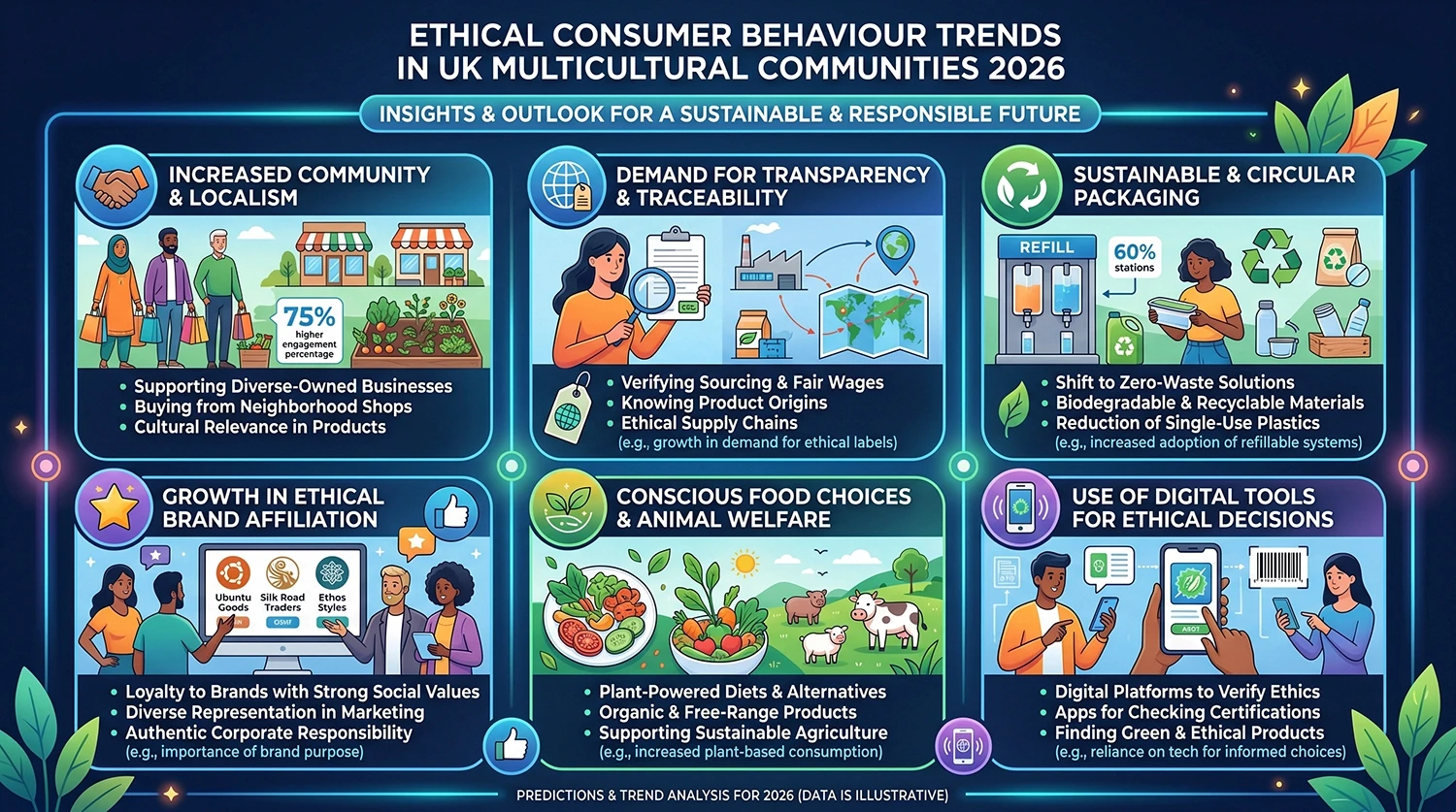
Consumers are becoming progressively more socially aware, and ethical consumerism is no longer a niche concern confined to metropolitan elites or activist circles. The source, background, production methods, and sustainability credentials of products and suppliers are now weighed with the same seriousness as price, image, and branding, particularly among certain consumer demographics. For multicultural marketers, this shift carries profound implications. The UK's diverse communities, many of which maintain strong transnational connections to countries where environmental and labour standards are immediate daily concerns, often demonstrate heightened sensitivity to ethical claims. Understanding this landscape is no longer optional for brands seeking to build lasting loyalty.
What Is a Social Enterprise?
A social enterprise is broadly defined as a business that seeks to maximise the amount of social good it creates, balanced carefully against its financial sustainability. This definition is distinct from the related concept of an "ethical business," which typically refers to a conventional company that attempts to minimise its negative impact on society or the environment. A social enterprise, by contrast, is structurally oriented toward positive impact as a primary objective.
The criteria for qualification as a social enterprise are specific and non-negotiable. First and most fundamentally, the business must possess a clear social and/or environmental mission, formally embedded in its governing documents. This ensures that purpose is not merely a marketing veneer but a legally binding commitment that shapes strategic decision-making. Second, the enterprise should generate the majority of its income through trade rather than grants or donations, ensuring commercial viability. Third, the majority of profits must be reinvested into furthering the social or environmental mission rather than distributed to private shareholders.
The UK boasts several high-profile examples that illustrate the breadth of what social enterprise can encompass. The Big Issue, the street newspaper sold by vendors experiencing homelessness, directly channels income to individuals who would otherwise struggle to access formal employment. Cafédirect, a Fairtrade hot drinks company, redirects premium pricing to coffee and cocoa farming communities across the developing world. Elvis & Kresse, a luggage and accessories brand, repurposes industrial waste products, particularly decommissioned fire hoses, into luxury goods while donating half of all profits to charities. These are not marginal operations. They are scalable, profitable businesses that prove commercial success and social impact are not mutually exclusive.

The Benefits of Social Cooperation
Entrepreneurs considering the social enterprise model will find that registration unlocks avenues for financing that remain closed to conventional businesses. A substantial ecosystem of grants and investment providers operates either primarily or exclusively for social enterprises, reflecting both government policy priorities and philanthropic capital allocation.
The UK government has announced significant funding streams directed at community, social, and environmental objectives. Notably, £750 million was committed in response to the COVID-19 pandemic to support organisations delivering social value during an unprecedented public health crisis. This level of state backing signals a long-term policy commitment that social entrepreneurs can factor into their strategic planning with reasonable confidence.
Beyond public funding, social investment providers offer capital on terms that often compare favourably to conventional commercial lending. The Esmée Fairbairn Foundation and Good Finance are prominent examples of institutions that provide social investment, a form of loan finance where the investor expects repayment, usually with interest. Critically, the interest rates on social investments are frequently considerably more favourable than those attached to standard business loans from high-street banks. This cost advantage can make a material difference to cash flow, growth trajectory, and the speed at which a social mission can be scaled.

Directory Networks and Corporate Procurement
There is also a powerful level of synergy and cooperation between registered social enterprises and the broader ecosystem of socially aware businesses. Social Enterprise UK maintains a comprehensive directory that helps social enterprises identify potential partners, suppliers, and collaborators. Similarly, the Social Enterprise Alliance and Social Enterprise Mark CIC maintain business directories exclusively catering to verified social enterprises, creating a trusted marketplace where ethical credentials are pre-validated.
For large corporations that cannot themselves qualify as social enterprises, partnering with registered social enterprises offers a credible pathway toward meeting social and environmental commitments. The UK’s Buy Social Corporate Challenge is actively encouraging major companies to collectively direct £1 billion of procurement spend toward social enterprises. This is not tokenistic corporate social responsibility. It is a structural reallocation of purchasing power that embeds ethical criteria into supply chain decision-making at scale.
Several global brands have already moved decisively in this direction. IKEA actively encourages its stores worldwide to establish partnerships with local social entrepreneurs, integrating ethical suppliers into retail operations rather than treating them as peripheral charity initiatives. eBay launched a dedicated shop front for social enterprises in February 2021, giving purpose-driven sellers direct access to one of the world's largest online marketplaces. Barclays provides mentoring programmes for social enterprises across the UK, transferring corporate expertise to organisations that might otherwise lack access to strategic guidance. These are not isolated gestures. They represent a mainstreaming of social enterprise into the architecture of British and global commerce.
"The source, background, production and sustainability of products and suppliers are becoming just as important as price, image and branding, especially to certain consumer demographics."
Mediareach Analysis, 2021
Ethical Spend at a Record High
Beyond the mechanics of financing and inter-business cooperation, ethical considerations are exerting a direct and measurable influence on consumer behaviour and spending patterns. The Ethical Consumer Markets Report provides the most authoritative tracking of this phenomenon, and its findings are striking. In 2019, ethical consumer spending in the United Kingdom reached a record high of £98 billion. This is not a marginal trend. It represents a substantial reorientation of household expenditure toward products and services that carry verified ethical credentials.
Perhaps more remarkably, this trajectory has persisted despite the severe economic disruption caused by the COVID-19 pandemic. While countless sectors contracted, consumers continued to seek out ethical and environmental alternatives, suggesting that ethical consumerism is rooted in social values rather than disposable income. When household budgets tighten, certain categories of spending are deferred or abandoned. The data indicates that ethical preferences are increasingly treated as non-negotiable.
Post-Pandemic Ethical Priorities
Comparing pre-pandemic statistics to more recent data reveals the acceleration of specific ethical concerns. An additional 15% of consumers now actively look for products that reduce energy consumption. An additional 19% prioritise reduced plastic packaging. An additional 12% make deliberate efforts to buy Fairtrade imported goods. These are not incremental shifts. They represent step-changes in consumer expectation that brands ignore at their commercial peril.
The type of product and the target demographic both influence the expression of ethical spending. Consumers are markedly more likely to make ethical choices in food and beverages, where Fairtrade, organic, and sustainable certifications are highly visible, and in green housewares, including energy-efficient appliances, LED lighting, and reusable products. By contrast, ethical criteria appear to exert less influence over purchasing in clothing and cosmetics, though even these categories are experiencing pressure for greater transparency.
Generational Divides in Ethical Consumption
While men and women appear broadly equally likely to make ethical choices, age emerges as the most significant demographic differentiator. Consumers over 65 years of age are the least likely to base purchasing decisions on ethical concerns, a finding that likely reflects both generational norms and the budget constraints that can accompany retirement. At the opposite end of the spectrum, Generation Z and Millennials are the most likely to be ethical consumers, a pattern that has held consistently across multiple survey waves.
A 2015 survey provided a particularly striking statistic: 42% of consumers aged 18-34 stated they would be prepared to pay a premium for products they consider to be ethically manufactured or sourced. This willingness to absorb higher prices for verified ethical credentials transforms ethical consumerism from a passive preference into an active market force. For brands targeting younger demographics, particularly within the UK's ethnically diverse Gen Z population, ethical positioning is not a nice-to-have. It is a baseline expectation.
Key Insight
The Ethical Consumer at a Glance
Total UK Ethical Spend (2019): £98 billion (record high)
Post-Pandemic Energy-Conscious Consumers: +15%
Post-Pandemic Plastic-Conscious Consumers: +19%
Post-Pandemic Fairtrade Buyers: +12%
Gen Z/Millennial Premium Willingness: 42% of 18-34 age group
Least Ethically Engaged Demographic: Consumers aged 65+
Highest Ethical Categories: Food & drink, green housewares
UK Social Enterprises: 100,000+ registered
A Trend Three Decades in the Making
The Ethical Consumer organisation has been tracking this sector of the market with methodological rigour since 1989, providing one of the longest continuous datasets on consumer values available to British marketers. The trend is unambiguous. Not only are more companies making explicit social and environmental commitments, but consumers are making choices that are increasingly influenced by ethical considerations across virtually every product category.
For multicultural marketers, this long-term trajectory intersects with another powerful demographic shift. The UK's ethnic minority communities, particularly younger cohorts, frequently maintain strong transnational ties to regions where environmental degradation, labour exploitation, and supply chain opacity are not abstract concerns but lived realities. This proximity to global production systems can amplify sensitivity to ethical claims and, conversely, intensify scepticism toward greenwashing or superficial corporate responsibility messaging.
Brands that communicate ethical credentials to multicultural audiences must therefore meet a higher bar for authenticity. Claims must be specific, verifiable, and culturally resonant. Generic sustainability slogans translated into community languages will not suffice. What is required is storytelling that connects a brand's ethical practices to the values and experiences of the communities it seeks to reach. This is where cultural intelligence becomes inseparable from ethical marketing.
Implications for Brand Strategy
The benefits of operating as a registered social enterprise are substantial and, by every available indicator, increasing over time. Yet not every business can restructure itself to meet the formal criteria. For conventional brands, there remains a powerful strategic opportunity: supporting and collaborating with registered social enterprises as suppliers, service providers, and campaign partners.
By directing procurement spend toward verified social enterprises, companies can make measurable progress toward their own social and environmental commitments while demonstrating to consumers that ethical business practices carry the same weight as price competitiveness and brand image. This is particularly salient for brands seeking to build loyalty among younger, more diverse consumer segments where ethical credentials function as a threshold requirement for brand consideration.
Marketing communications must also evolve. Ethical claims should be integrated into the core narrative rather than relegated to corporate responsibility microsites or annual sustainability reports. For multicultural campaigns, this means identifying social enterprises within target communities and co-creating content that highlights mutual values. A campaign targeting British Bangladeshi consumers, for example, might partner with a social enterprise working on environmental restoration in Bangladesh, creating a narrative thread that connects local purchasing decisions to tangible impact in a country of origin.
Conclusion: Ethics as the New Baseline
The evidence accumulated over three decades of market tracking, and accelerated by the social and economic disruptions of the COVID-19 pandemic, points to a single conclusion. Ethical consumerism is not a passing trend or a luxury concern that recedes when household budgets contract. It is a structural reorientation of consumer values that is most pronounced among the youngest, most diverse, and most digitally engaged demographics in the UK.
For brands, the strategic imperative is clear. Social enterprises represent a proven model for embedding purpose into profitability. Ethical consumer spending has reached unprecedented scale. And the consumers who will define British retail over the coming decades expect the brands they support to demonstrate genuine commitment to social and environmental goals. Meeting this expectation requires more than policy adjustments. It requires marketing that speaks authentically to the values of the communities brands seek to serve. Mediareach's four-decade track record of culturally intelligent campaign development offers a proven pathway to achieving precisely that.
Reach the UK's Most Ethically Engaged Consumers
Mediareach combines four decades of multicultural expertise with deep understanding of how ethical values drive purchasing decisions across Britain's diverse communities. Build campaigns that resonate with the consumers shaping the future of British retail.
Sources & References
Social Enterprise UK, "State of Social Enterprise Report," 2021. socialenterprise.org.uk
Ethical Consumer Research Association, "Ethical Consumer Markets Report 2019." ethicalconsumer.org
UK Government, "Social Enterprise and Grant Funding Announcements," 2020-2021. gov.uk
Esmée Fairbairn Foundation, "Social Investment Strategy." esmeefairbairn.org.uk
Good Finance, "Social Investment for Social Enterprises." goodfinance.org.uk
Buy Social Corporate Challenge, "Procurement Targets and Progress." socialenterprise.org.uk
IKEA, "Social Entrepreneurship Partnerships," Corporate Sustainability Report, 2021. ikea.com
eBay, "Social Enterprise Shop Front Launch," Press Release, February 2021. ebay.co.uk
Barclays, "Social Enterprise Mentoring Programme," 2021. barclays.co.uk
Mediareach Advertising, "Multicultural Marketing & Ethical Consumer Strategy," Services, 2021. mediareach.co
social enterprises UK
ethical consumerism
ethical consumer spending
social enterprise marketing
ethical marketing strategy
Gen Z ethical consumers
Fairtrade consumer trends
sustainable business UK
social enterprise procurement
Buy Social Corporate Challenge
ethical consumer markets report
multicultural ethical marketing
social investment UK
green consumer behaviour
purpose driven brands
The UK's pioneering multicultural marketing and advertising agency. Over 40 years connecting brands with diverse communities through cultural insight, creative excellence, and intelligent media strategy. mediareach.co


Jan 29, 2026
Social Enterprises: How Ethical Choices Are Driving Consumer Behaviour in the UK
With over 100,000 registered social enterprises and ethical consumer spending reaching £98 billion, the UK is witnessing a fundamental shift in what drives purchasing decisions. Here is what brands need to understand about the ethical consumer revolution.
⏱ 8 min read
By mediareach
The United Kingdom alone is home to more than 100,000 businesses and organisations registered as social enterprises. This vast network is not merely a footnote in Britain's economic landscape. It represents one of the most significant structural shifts in how commerce, community, and conscience intersect in the twenty-first century. Social enterprises have a well-documented tendency to collaborate, sharing resources, knowledge, and distribution channels in support of their mutual social and ethical commitments. But the story extends far beyond the boardrooms and supply chains of these purpose-driven businesses.
Consumers are becoming progressively more socially aware, and ethical consumerism is no longer a niche concern confined to metropolitan elites or activist circles. The source, background, production methods, and sustainability credentials of products and suppliers are now weighed with the same seriousness as price, image, and branding, particularly among certain consumer demographics. For multicultural marketers, this shift carries profound implications. The UK's diverse communities, many of which maintain strong transnational connections to countries where environmental and labour standards are immediate daily concerns, often demonstrate heightened sensitivity to ethical claims. Understanding this landscape is no longer optional for brands seeking to build lasting loyalty.
What Is a Social Enterprise?
A social enterprise is broadly defined as a business that seeks to maximise the amount of social good it creates, balanced carefully against its financial sustainability. This definition is distinct from the related concept of an "ethical business," which typically refers to a conventional company that attempts to minimise its negative impact on society or the environment. A social enterprise, by contrast, is structurally oriented toward positive impact as a primary objective.
The criteria for qualification as a social enterprise are specific and non-negotiable. First and most fundamentally, the business must possess a clear social and/or environmental mission, formally embedded in its governing documents. This ensures that purpose is not merely a marketing veneer but a legally binding commitment that shapes strategic decision-making. Second, the enterprise should generate the majority of its income through trade rather than grants or donations, ensuring commercial viability. Third, the majority of profits must be reinvested into furthering the social or environmental mission rather than distributed to private shareholders.
The UK boasts several high-profile examples that illustrate the breadth of what social enterprise can encompass. The Big Issue, the street newspaper sold by vendors experiencing homelessness, directly channels income to individuals who would otherwise struggle to access formal employment. Cafédirect, a Fairtrade hot drinks company, redirects premium pricing to coffee and cocoa farming communities across the developing world. Elvis & Kresse, a luggage and accessories brand, repurposes industrial waste products, particularly decommissioned fire hoses, into luxury goods while donating half of all profits to charities. These are not marginal operations. They are scalable, profitable businesses that prove commercial success and social impact are not mutually exclusive.
The Benefits of Social Cooperation
Entrepreneurs considering the social enterprise model will find that registration unlocks avenues for financing that remain closed to conventional businesses. A substantial ecosystem of grants and investment providers operates either primarily or exclusively for social enterprises, reflecting both government policy priorities and philanthropic capital allocation.
The UK government has announced significant funding streams directed at community, social, and environmental objectives. Notably, £750 million was committed in response to the COVID-19 pandemic to support organisations delivering social value during an unprecedented public health crisis. This level of state backing signals a long-term policy commitment that social entrepreneurs can factor into their strategic planning with reasonable confidence.
Beyond public funding, social investment providers offer capital on terms that often compare favourably to conventional commercial lending. The Esmée Fairbairn Foundation and Good Finance are prominent examples of institutions that provide social investment, a form of loan finance where the investor expects repayment, usually with interest. Critically, the interest rates on social investments are frequently considerably more favourable than those attached to standard business loans from high-street banks. This cost advantage can make a material difference to cash flow, growth trajectory, and the speed at which a social mission can be scaled.
Directory Networks and Corporate Procurement
There is also a powerful level of synergy and cooperation between registered social enterprises and the broader ecosystem of socially aware businesses. Social Enterprise UK maintains a comprehensive directory that helps social enterprises identify potential partners, suppliers, and collaborators. Similarly, the Social Enterprise Alliance and Social Enterprise Mark CIC maintain business directories exclusively catering to verified social enterprises, creating a trusted marketplace where ethical credentials are pre-validated.
For large corporations that cannot themselves qualify as social enterprises, partnering with registered social enterprises offers a credible pathway toward meeting social and environmental commitments. The UK’s Buy Social Corporate Challenge is actively encouraging major companies to collectively direct £1 billion of procurement spend toward social enterprises. This is not tokenistic corporate social responsibility. It is a structural reallocation of purchasing power that embeds ethical criteria into supply chain decision-making at scale.
Several global brands have already moved decisively in this direction. IKEA actively encourages its stores worldwide to establish partnerships with local social entrepreneurs, integrating ethical suppliers into retail operations rather than treating them as peripheral charity initiatives. eBay launched a dedicated shop front for social enterprises in February 2021, giving purpose-driven sellers direct access to one of the world's largest online marketplaces. Barclays provides mentoring programmes for social enterprises across the UK, transferring corporate expertise to organisations that might otherwise lack access to strategic guidance. These are not isolated gestures. They represent a mainstreaming of social enterprise into the architecture of British and global commerce.
"The source, background, production and sustainability of products and suppliers are becoming just as important as price, image and branding, especially to certain consumer demographics."
Mediareach Analysis, 2021
Ethical Spend at a Record High
Beyond the mechanics of financing and inter-business cooperation, ethical considerations are exerting a direct and measurable influence on consumer behaviour and spending patterns. The Ethical Consumer Markets Report provides the most authoritative tracking of this phenomenon, and its findings are striking. In 2019, ethical consumer spending in the United Kingdom reached a record high of £98 billion. This is not a marginal trend. It represents a substantial reorientation of household expenditure toward products and services that carry verified ethical credentials.
Perhaps more remarkably, this trajectory has persisted despite the severe economic disruption caused by the COVID-19 pandemic. While countless sectors contracted, consumers continued to seek out ethical and environmental alternatives, suggesting that ethical consumerism is rooted in social values rather than disposable income. When household budgets tighten, certain categories of spending are deferred or abandoned. The data indicates that ethical preferences are increasingly treated as non-negotiable.
Post-Pandemic Ethical Priorities
Comparing pre-pandemic statistics to more recent data reveals the acceleration of specific ethical concerns. An additional 15% of consumers now actively look for products that reduce energy consumption. An additional 19% prioritise reduced plastic packaging. An additional 12% make deliberate efforts to buy Fairtrade imported goods. These are not incremental shifts. They represent step-changes in consumer expectation that brands ignore at their commercial peril.
The type of product and the target demographic both influence the expression of ethical spending. Consumers are markedly more likely to make ethical choices in food and beverages, where Fairtrade, organic, and sustainable certifications are highly visible, and in green housewares, including energy-efficient appliances, LED lighting, and reusable products. By contrast, ethical criteria appear to exert less influence over purchasing in clothing and cosmetics, though even these categories are experiencing pressure for greater transparency.
Generational Divides in Ethical Consumption
While men and women appear broadly equally likely to make ethical choices, age emerges as the most significant demographic differentiator. Consumers over 65 years of age are the least likely to base purchasing decisions on ethical concerns, a finding that likely reflects both generational norms and the budget constraints that can accompany retirement. At the opposite end of the spectrum, Generation Z and Millennials are the most likely to be ethical consumers, a pattern that has held consistently across multiple survey waves.
A 2015 survey provided a particularly striking statistic: 42% of consumers aged 18-34 stated they would be prepared to pay a premium for products they consider to be ethically manufactured or sourced. This willingness to absorb higher prices for verified ethical credentials transforms ethical consumerism from a passive preference into an active market force. For brands targeting younger demographics, particularly within the UK's ethnically diverse Gen Z population, ethical positioning is not a nice-to-have. It is a baseline expectation.
Key Insight
The Ethical Consumer at a Glance
Total UK Ethical Spend (2019): £98 billion (record high)
Post-Pandemic Energy-Conscious Consumers: +15%
Post-Pandemic Plastic-Conscious Consumers: +19%
Post-Pandemic Fairtrade Buyers: +12%
Gen Z/Millennial Premium Willingness: 42% of 18-34 age group
Least Ethically Engaged Demographic: Consumers aged 65+
Highest Ethical Categories: Food & drink, green housewares
UK Social Enterprises: 100,000+ registered
A Trend Three Decades in the Making
The Ethical Consumer organisation has been tracking this sector of the market with methodological rigour since 1989, providing one of the longest continuous datasets on consumer values available to British marketers. The trend is unambiguous. Not only are more companies making explicit social and environmental commitments, but consumers are making choices that are increasingly influenced by ethical considerations across virtually every product category.
For multicultural marketers, this long-term trajectory intersects with another powerful demographic shift. The UK's ethnic minority communities, particularly younger cohorts, frequently maintain strong transnational ties to regions where environmental degradation, labour exploitation, and supply chain opacity are not abstract concerns but lived realities. This proximity to global production systems can amplify sensitivity to ethical claims and, conversely, intensify scepticism toward greenwashing or superficial corporate responsibility messaging.
Brands that communicate ethical credentials to multicultural audiences must therefore meet a higher bar for authenticity. Claims must be specific, verifiable, and culturally resonant. Generic sustainability slogans translated into community languages will not suffice. What is required is storytelling that connects a brand's ethical practices to the values and experiences of the communities it seeks to reach. This is where cultural intelligence becomes inseparable from ethical marketing.
Implications for Brand Strategy
The benefits of operating as a registered social enterprise are substantial and, by every available indicator, increasing over time. Yet not every business can restructure itself to meet the formal criteria. For conventional brands, there remains a powerful strategic opportunity: supporting and collaborating with registered social enterprises as suppliers, service providers, and campaign partners.
By directing procurement spend toward verified social enterprises, companies can make measurable progress toward their own social and environmental commitments while demonstrating to consumers that ethical business practices carry the same weight as price competitiveness and brand image. This is particularly salient for brands seeking to build loyalty among younger, more diverse consumer segments where ethical credentials function as a threshold requirement for brand consideration.
Marketing communications must also evolve. Ethical claims should be integrated into the core narrative rather than relegated to corporate responsibility microsites or annual sustainability reports. For multicultural campaigns, this means identifying social enterprises within target communities and co-creating content that highlights mutual values. A campaign targeting British Bangladeshi consumers, for example, might partner with a social enterprise working on environmental restoration in Bangladesh, creating a narrative thread that connects local purchasing decisions to tangible impact in a country of origin.
Conclusion: Ethics as the New Baseline
The evidence accumulated over three decades of market tracking, and accelerated by the social and economic disruptions of the COVID-19 pandemic, points to a single conclusion. Ethical consumerism is not a passing trend or a luxury concern that recedes when household budgets contract. It is a structural reorientation of consumer values that is most pronounced among the youngest, most diverse, and most digitally engaged demographics in the UK.
For brands, the strategic imperative is clear. Social enterprises represent a proven model for embedding purpose into profitability. Ethical consumer spending has reached unprecedented scale. And the consumers who will define British retail over the coming decades expect the brands they support to demonstrate genuine commitment to social and environmental goals. Meeting this expectation requires more than policy adjustments. It requires marketing that speaks authentically to the values of the communities brands seek to serve. Mediareach's four-decade track record of culturally intelligent campaign development offers a proven pathway to achieving precisely that.
Reach the UK's Most Ethically Engaged Consumers
Mediareach combines four decades of multicultural expertise with deep understanding of how ethical values drive purchasing decisions across Britain's diverse communities. Build campaigns that resonate with the consumers shaping the future of British retail.
Sources & References
Social Enterprise UK, "State of Social Enterprise Report," 2021. socialenterprise.org.uk
Ethical Consumer Research Association, "Ethical Consumer Markets Report 2019." ethicalconsumer.org
UK Government, "Social Enterprise and Grant Funding Announcements," 2020-2021. gov.uk
Esmée Fairbairn Foundation, "Social Investment Strategy." esmeefairbairn.org.uk
Good Finance, "Social Investment for Social Enterprises." goodfinance.org.uk
Buy Social Corporate Challenge, "Procurement Targets and Progress." socialenterprise.org.uk
IKEA, "Social Entrepreneurship Partnerships," Corporate Sustainability Report, 2021. ikea.com
eBay, "Social Enterprise Shop Front Launch," Press Release, February 2021. ebay.co.uk
Barclays, "Social Enterprise Mentoring Programme," 2021. barclays.co.uk
Mediareach Advertising, "Multicultural Marketing & Ethical Consumer Strategy," Services, 2021. mediareach.co
social enterprises UK
ethical consumerism
ethical consumer spending
social enterprise marketing
ethical marketing strategy
Gen Z ethical consumers
Fairtrade consumer trends
sustainable business UK
social enterprise procurement
Buy Social Corporate Challenge
ethical consumer markets report
multicultural ethical marketing
social investment UK
green consumer behaviour
purpose driven brands
The UK's pioneering multicultural marketing and advertising agency. Over 40 years connecting brands with diverse communities through cultural insight, creative excellence, and intelligent media strategy. mediareach.co
Jan 29, 2026
Social Enterprises: How Ethical Choices Are Driving Consumer Behaviour in the UK
With over 100,000 registered social enterprises and ethical consumer spending reaching £98 billion, the UK is witnessing a fundamental shift in what drives purchasing decisions. Here is what brands need to understand about the ethical consumer revolution.
⏱ 8 min read
By mediareach
The United Kingdom alone is home to more than 100,000 businesses and organisations registered as social enterprises. This vast network is not merely a footnote in Britain's economic landscape. It represents one of the most significant structural shifts in how commerce, community, and conscience intersect in the twenty-first century. Social enterprises have a well-documented tendency to collaborate, sharing resources, knowledge, and distribution channels in support of their mutual social and ethical commitments. But the story extends far beyond the boardrooms and supply chains of these purpose-driven businesses.
Consumers are becoming progressively more socially aware, and ethical consumerism is no longer a niche concern confined to metropolitan elites or activist circles. The source, background, production methods, and sustainability credentials of products and suppliers are now weighed with the same seriousness as price, image, and branding, particularly among certain consumer demographics. For multicultural marketers, this shift carries profound implications. The UK's diverse communities, many of which maintain strong transnational connections to countries where environmental and labour standards are immediate daily concerns, often demonstrate heightened sensitivity to ethical claims. Understanding this landscape is no longer optional for brands seeking to build lasting loyalty.
What Is a Social Enterprise?
A social enterprise is broadly defined as a business that seeks to maximise the amount of social good it creates, balanced carefully against its financial sustainability. This definition is distinct from the related concept of an "ethical business," which typically refers to a conventional company that attempts to minimise its negative impact on society or the environment. A social enterprise, by contrast, is structurally oriented toward positive impact as a primary objective.
The criteria for qualification as a social enterprise are specific and non-negotiable. First and most fundamentally, the business must possess a clear social and/or environmental mission, formally embedded in its governing documents. This ensures that purpose is not merely a marketing veneer but a legally binding commitment that shapes strategic decision-making. Second, the enterprise should generate the majority of its income through trade rather than grants or donations, ensuring commercial viability. Third, the majority of profits must be reinvested into furthering the social or environmental mission rather than distributed to private shareholders.
The UK boasts several high-profile examples that illustrate the breadth of what social enterprise can encompass. The Big Issue, the street newspaper sold by vendors experiencing homelessness, directly channels income to individuals who would otherwise struggle to access formal employment. Cafédirect, a Fairtrade hot drinks company, redirects premium pricing to coffee and cocoa farming communities across the developing world. Elvis & Kresse, a luggage and accessories brand, repurposes industrial waste products, particularly decommissioned fire hoses, into luxury goods while donating half of all profits to charities. These are not marginal operations. They are scalable, profitable businesses that prove commercial success and social impact are not mutually exclusive.
The Benefits of Social Cooperation
Entrepreneurs considering the social enterprise model will find that registration unlocks avenues for financing that remain closed to conventional businesses. A substantial ecosystem of grants and investment providers operates either primarily or exclusively for social enterprises, reflecting both government policy priorities and philanthropic capital allocation.
The UK government has announced significant funding streams directed at community, social, and environmental objectives. Notably, £750 million was committed in response to the COVID-19 pandemic to support organisations delivering social value during an unprecedented public health crisis. This level of state backing signals a long-term policy commitment that social entrepreneurs can factor into their strategic planning with reasonable confidence.
Beyond public funding, social investment providers offer capital on terms that often compare favourably to conventional commercial lending. The Esmée Fairbairn Foundation and Good Finance are prominent examples of institutions that provide social investment, a form of loan finance where the investor expects repayment, usually with interest. Critically, the interest rates on social investments are frequently considerably more favourable than those attached to standard business loans from high-street banks. This cost advantage can make a material difference to cash flow, growth trajectory, and the speed at which a social mission can be scaled.
Directory Networks and Corporate Procurement
There is also a powerful level of synergy and cooperation between registered social enterprises and the broader ecosystem of socially aware businesses. Social Enterprise UK maintains a comprehensive directory that helps social enterprises identify potential partners, suppliers, and collaborators. Similarly, the Social Enterprise Alliance and Social Enterprise Mark CIC maintain business directories exclusively catering to verified social enterprises, creating a trusted marketplace where ethical credentials are pre-validated.
For large corporations that cannot themselves qualify as social enterprises, partnering with registered social enterprises offers a credible pathway toward meeting social and environmental commitments. The UK’s Buy Social Corporate Challenge is actively encouraging major companies to collectively direct £1 billion of procurement spend toward social enterprises. This is not tokenistic corporate social responsibility. It is a structural reallocation of purchasing power that embeds ethical criteria into supply chain decision-making at scale.
Several global brands have already moved decisively in this direction. IKEA actively encourages its stores worldwide to establish partnerships with local social entrepreneurs, integrating ethical suppliers into retail operations rather than treating them as peripheral charity initiatives. eBay launched a dedicated shop front for social enterprises in February 2021, giving purpose-driven sellers direct access to one of the world's largest online marketplaces. Barclays provides mentoring programmes for social enterprises across the UK, transferring corporate expertise to organisations that might otherwise lack access to strategic guidance. These are not isolated gestures. They represent a mainstreaming of social enterprise into the architecture of British and global commerce.
"The source, background, production and sustainability of products and suppliers are becoming just as important as price, image and branding, especially to certain consumer demographics."
Mediareach Analysis, 2021
Ethical Spend at a Record High
Beyond the mechanics of financing and inter-business cooperation, ethical considerations are exerting a direct and measurable influence on consumer behaviour and spending patterns. The Ethical Consumer Markets Report provides the most authoritative tracking of this phenomenon, and its findings are striking. In 2019, ethical consumer spending in the United Kingdom reached a record high of £98 billion. This is not a marginal trend. It represents a substantial reorientation of household expenditure toward products and services that carry verified ethical credentials.
Perhaps more remarkably, this trajectory has persisted despite the severe economic disruption caused by the COVID-19 pandemic. While countless sectors contracted, consumers continued to seek out ethical and environmental alternatives, suggesting that ethical consumerism is rooted in social values rather than disposable income. When household budgets tighten, certain categories of spending are deferred or abandoned. The data indicates that ethical preferences are increasingly treated as non-negotiable.
Post-Pandemic Ethical Priorities
Comparing pre-pandemic statistics to more recent data reveals the acceleration of specific ethical concerns. An additional 15% of consumers now actively look for products that reduce energy consumption. An additional 19% prioritise reduced plastic packaging. An additional 12% make deliberate efforts to buy Fairtrade imported goods. These are not incremental shifts. They represent step-changes in consumer expectation that brands ignore at their commercial peril.
The type of product and the target demographic both influence the expression of ethical spending. Consumers are markedly more likely to make ethical choices in food and beverages, where Fairtrade, organic, and sustainable certifications are highly visible, and in green housewares, including energy-efficient appliances, LED lighting, and reusable products. By contrast, ethical criteria appear to exert less influence over purchasing in clothing and cosmetics, though even these categories are experiencing pressure for greater transparency.
Generational Divides in Ethical Consumption
While men and women appear broadly equally likely to make ethical choices, age emerges as the most significant demographic differentiator. Consumers over 65 years of age are the least likely to base purchasing decisions on ethical concerns, a finding that likely reflects both generational norms and the budget constraints that can accompany retirement. At the opposite end of the spectrum, Generation Z and Millennials are the most likely to be ethical consumers, a pattern that has held consistently across multiple survey waves.
A 2015 survey provided a particularly striking statistic: 42% of consumers aged 18-34 stated they would be prepared to pay a premium for products they consider to be ethically manufactured or sourced. This willingness to absorb higher prices for verified ethical credentials transforms ethical consumerism from a passive preference into an active market force. For brands targeting younger demographics, particularly within the UK's ethnically diverse Gen Z population, ethical positioning is not a nice-to-have. It is a baseline expectation.
Key Insight
The Ethical Consumer at a Glance
Total UK Ethical Spend (2019): £98 billion (record high)
Post-Pandemic Energy-Conscious Consumers: +15%
Post-Pandemic Plastic-Conscious Consumers: +19%
Post-Pandemic Fairtrade Buyers: +12%
Gen Z/Millennial Premium Willingness: 42% of 18-34 age group
Least Ethically Engaged Demographic: Consumers aged 65+
Highest Ethical Categories: Food & drink, green housewares
UK Social Enterprises: 100,000+ registered
A Trend Three Decades in the Making
The Ethical Consumer organisation has been tracking this sector of the market with methodological rigour since 1989, providing one of the longest continuous datasets on consumer values available to British marketers. The trend is unambiguous. Not only are more companies making explicit social and environmental commitments, but consumers are making choices that are increasingly influenced by ethical considerations across virtually every product category.
For multicultural marketers, this long-term trajectory intersects with another powerful demographic shift. The UK's ethnic minority communities, particularly younger cohorts, frequently maintain strong transnational ties to regions where environmental degradation, labour exploitation, and supply chain opacity are not abstract concerns but lived realities. This proximity to global production systems can amplify sensitivity to ethical claims and, conversely, intensify scepticism toward greenwashing or superficial corporate responsibility messaging.
Brands that communicate ethical credentials to multicultural audiences must therefore meet a higher bar for authenticity. Claims must be specific, verifiable, and culturally resonant. Generic sustainability slogans translated into community languages will not suffice. What is required is storytelling that connects a brand's ethical practices to the values and experiences of the communities it seeks to reach. This is where cultural intelligence becomes inseparable from ethical marketing.
Implications for Brand Strategy
The benefits of operating as a registered social enterprise are substantial and, by every available indicator, increasing over time. Yet not every business can restructure itself to meet the formal criteria. For conventional brands, there remains a powerful strategic opportunity: supporting and collaborating with registered social enterprises as suppliers, service providers, and campaign partners.
By directing procurement spend toward verified social enterprises, companies can make measurable progress toward their own social and environmental commitments while demonstrating to consumers that ethical business practices carry the same weight as price competitiveness and brand image. This is particularly salient for brands seeking to build loyalty among younger, more diverse consumer segments where ethical credentials function as a threshold requirement for brand consideration.
Marketing communications must also evolve. Ethical claims should be integrated into the core narrative rather than relegated to corporate responsibility microsites or annual sustainability reports. For multicultural campaigns, this means identifying social enterprises within target communities and co-creating content that highlights mutual values. A campaign targeting British Bangladeshi consumers, for example, might partner with a social enterprise working on environmental restoration in Bangladesh, creating a narrative thread that connects local purchasing decisions to tangible impact in a country of origin.
Conclusion: Ethics as the New Baseline
The evidence accumulated over three decades of market tracking, and accelerated by the social and economic disruptions of the COVID-19 pandemic, points to a single conclusion. Ethical consumerism is not a passing trend or a luxury concern that recedes when household budgets contract. It is a structural reorientation of consumer values that is most pronounced among the youngest, most diverse, and most digitally engaged demographics in the UK.
For brands, the strategic imperative is clear. Social enterprises represent a proven model for embedding purpose into profitability. Ethical consumer spending has reached unprecedented scale. And the consumers who will define British retail over the coming decades expect the brands they support to demonstrate genuine commitment to social and environmental goals. Meeting this expectation requires more than policy adjustments. It requires marketing that speaks authentically to the values of the communities brands seek to serve. Mediareach's four-decade track record of culturally intelligent campaign development offers a proven pathway to achieving precisely that.
Reach the UK's Most Ethically Engaged Consumers
Mediareach combines four decades of multicultural expertise with deep understanding of how ethical values drive purchasing decisions across Britain's diverse communities. Build campaigns that resonate with the consumers shaping the future of British retail.
Sources & References
Social Enterprise UK, "State of Social Enterprise Report," 2021. socialenterprise.org.uk
Ethical Consumer Research Association, "Ethical Consumer Markets Report 2019." ethicalconsumer.org
UK Government, "Social Enterprise and Grant Funding Announcements," 2020-2021. gov.uk
Esmée Fairbairn Foundation, "Social Investment Strategy." esmeefairbairn.org.uk
Good Finance, "Social Investment for Social Enterprises." goodfinance.org.uk
Buy Social Corporate Challenge, "Procurement Targets and Progress." socialenterprise.org.uk
IKEA, "Social Entrepreneurship Partnerships," Corporate Sustainability Report, 2021. ikea.com
eBay, "Social Enterprise Shop Front Launch," Press Release, February 2021. ebay.co.uk
Barclays, "Social Enterprise Mentoring Programme," 2021. barclays.co.uk
Mediareach Advertising, "Multicultural Marketing & Ethical Consumer Strategy," Services, 2021. mediareach.co
social enterprises UK
ethical consumerism
ethical consumer spending
social enterprise marketing
ethical marketing strategy
Gen Z ethical consumers
Fairtrade consumer trends
sustainable business UK
social enterprise procurement
Buy Social Corporate Challenge
ethical consumer markets report
multicultural ethical marketing
social investment UK
green consumer behaviour
purpose driven brands
The UK's pioneering multicultural marketing and advertising agency. Over 40 years connecting brands with diverse communities through cultural insight, creative excellence, and intelligent media strategy. mediareach.co