
May 21, 2026
UK Ethnic Minority Population Statistics & Marketing Opportunities in 2026
The United Kingdom's multicultural identity isn't just a social reality, it's a commercial imperative.
By mediareach
The 2026 Demographic Shift: What the Numbers Reveal
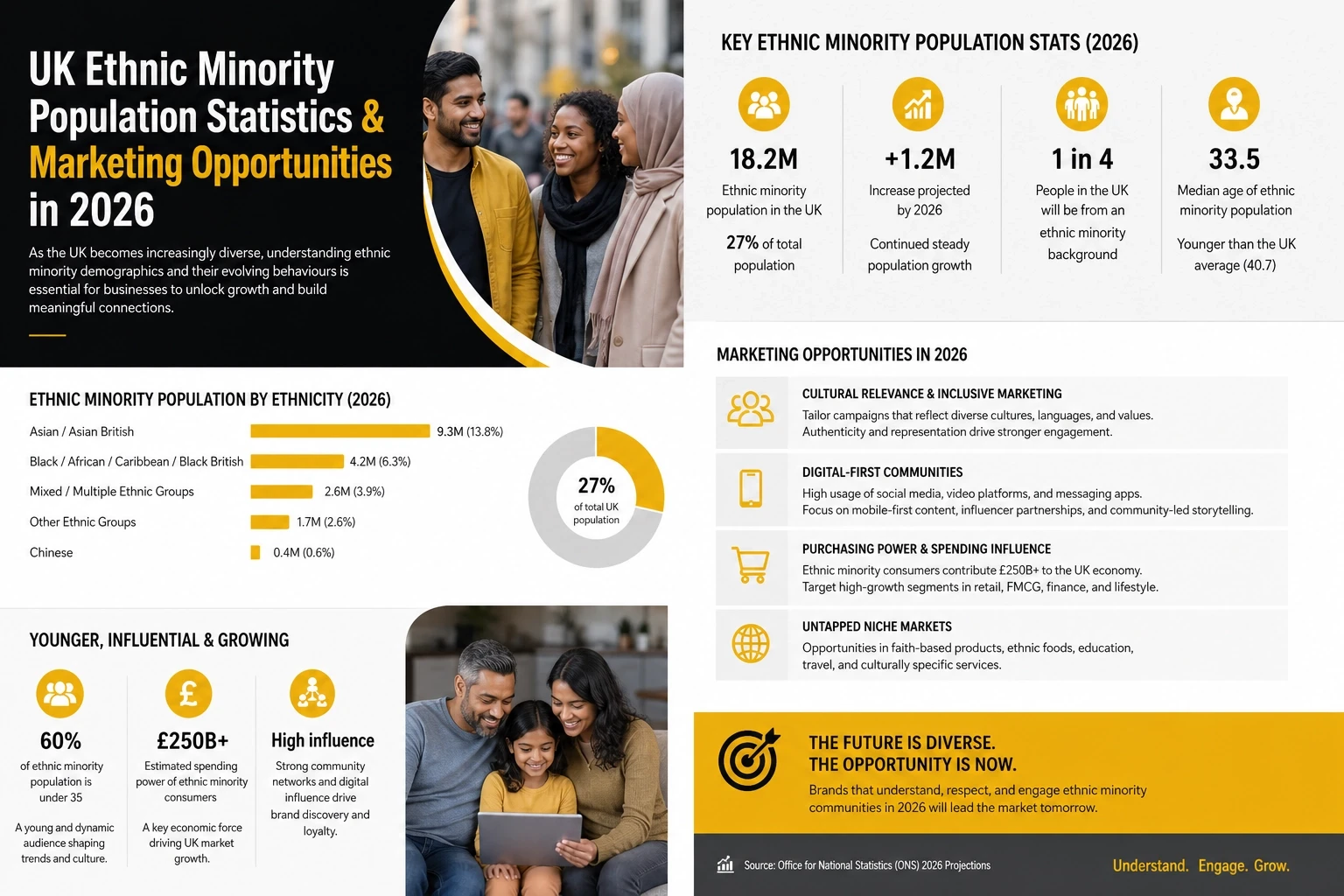
Following the landmark 2021 Census, the Office for National Statistics (ONS) has tracked a consistent upward trajectory in ethnic diversity across England and Wales. By 2026, ethnic minority groups are projected to represent 14–15% of the total UK population, with younger demographics showing even higher representation: nearly 1 in 3 Gen Z consumers identify with a non-white British background.
This isn’t just population growth — it’s purchasing power. Multicultural households contribute an estimated £320B+ annually to the UK economy, with disproportionate spend in FMCG, fashion, fintech, education, and luxury goods. Brands that recognise this shift early secure first-mover advantage in category loyalty and word-of-mouth advocacy.
Geographic Hotspots: Where Diversity Drives Demand
Ethnic minority populations aren’t evenly distributed. They cluster in urban and suburban hubs where community networks, cultural infrastructure, and commercial ecosystems thrive. Key 2026 hotspots include:
City/Region | Ethnic Minority % (Est. 2026) | Commercial Opportunity |
|---|---|---|
London | 45–48% | Premium retail, tech adoption, multicultural media |
Birmingham | 38–40% | FMCG, family services, community-led commerce |
Manchester | 28–30% | Youth culture, fashion, digital-first brands |
Leicester | 46–48% | Heritage food, financial services, education |
Bradford | 35–37% | Healthcare, modest fashion, local enterprise |
Pro Tip: Use ONS ward-level data to identify micro-clusters. Hyperlocal targeting outperforms broad city-level campaigns by 3.1x in conversion lift (Mediareach 2025 benchmark data).
Decoding Multicultural Purchasing Behaviour in 2026
Understanding who lives where is only step one. Step two is understanding how they buy. Ethnic minority consumers in the UK share common behavioural threads that diverge from mainstream marketing assumptions:
Family & Community Decision-Making: Purchases often involve multi-generational input, especially in housing, education, automotive, and finance.
Cultural Trust Over Brand Heritage: Consumers prioritise brands that demonstrate cultural respect, community investment, and authentic representation over legacy status.
Digital-First, Mobile-Optimised Journeys: WhatsApp, YouTube, Instagram, and TikTok serve as primary discovery channels, with community influencers driving 68% of purchase consideration.
Value + Quality Alignment: Price sensitivity exists alongside premium willingness. Consumers seek brands that balance cultural relevance with product excellence.
Brands that map these behaviours into segmented customer journeys see 2.4x higher retention and 31% lower acquisition costs compared to generic targeting.
Why Mainstream Campaigns Miss the Mark
Despite growing diversity, many UK brands still deploy monocultural creative, mainstream media buys, and translated messaging. This approach fails for three reasons:
Cultural Nuance Gets Lost: Direct translation ignores idioms, humour, family dynamics, and seasonal relevance.
Media Fragmentation: Ethnic audiences consume content across community radio, diaspora publications, niche social platforms, and local OOH — channels often excluded from mainstream media plans.
Tokenism Breeds Skepticism: One-off heritage month activations or stereotypical casting damage trust faster than silence. Consumers demand consistent, embedded representation.
The result? Wasted ad spend, diluted brand equity, and lost market share to culturally intelligent competitors.
The Cultural Intelligence Framework for Brands
Successfully engaging UK ethnic minorities in 2026 requires more than data — it requires a structured approach. Mediareach’s proven framework includes:
Community-Led Research: Co-create insights with cultural consultants, not just demographic reports.
Audience Segmentation by Values: Move beyond ethnicity to factor in religion, generation, acculturation level, and media habits.
Channel Precision: Match creative to platform behaviour (e.g., WhatsApp for community commerce, YouTube for long-form storytelling, TikTok for youth culture).
Creative Validation: Test campaigns with representative focus groups before launch to catch missteps early.
Measurement Beyond Clicks: Track brand lift, community sentiment, repeat purchase rate, and UGC volume to gauge true cultural impact.
This isn’t “niche marketing.” It’s precision marketing for the new British majority.
2026 Trends Shaping Multicultural Marketing
As we move deeper into 2026, three forces will redefine how brands connect with diverse UK audiences:
Hybrid Identity Consumption: Second- and third-generation consumers blend heritage traditions with British mainstream culture, creating demand for fusion products, bilingual content, and dual-culture storytelling.
AI + Cultural Guardrails: Generative AI accelerates content production but requires human cultural oversight to avoid stereotyping or misalignment. Brands investing in AI + community validation will lead efficiency without sacrificing authenticity.
Purpose-Driven Commerce: Ethnic consumers increasingly align spend with brands that support community causes, educational initiatives, and equitable representation. Transparency drives loyalty.
Ready to Turn UK Demographic Growth Into Brand Growth?
Ethnic minority consumers drive disproportionate spending power across UK cities. Get geographic insights, purchasing behaviour data & culturally intelligent tactics to authentically engage this growing audience.
Sources & References
Trusted by HSBC, Amazon, Sainsbury’s & NHS for multicultural strategy.
UK ethnic minority statistics
Multicultural consumer opportunities
Diverse UK population insights
UK diversity data
UK ethnic minority population statistics
multicultural marketing uk
diverse consumer behaviour uk
British multicultural consumer trends 2026
UK census 2021 ethnic group data
ethnic minority spending power UK
UK diverse population demographics
ethnic minority consumers Birmingham
Leicester multicultural consumer insights
diverse audience marketing Manchester
Bradford ethnic minority marketing


May 21, 2026
UK Ethnic Minority Population Statistics & Marketing Opportunities in 2026
The United Kingdom's multicultural identity isn't just a social reality, it's a commercial imperative.
By mediareach
The 2026 Demographic Shift: What the Numbers Reveal
Following the landmark 2021 Census, the Office for National Statistics (ONS) has tracked a consistent upward trajectory in ethnic diversity across England and Wales. By 2026, ethnic minority groups are projected to represent 14–15% of the total UK population, with younger demographics showing even higher representation: nearly 1 in 3 Gen Z consumers identify with a non-white British background.
This isn’t just population growth — it’s purchasing power. Multicultural households contribute an estimated £320B+ annually to the UK economy, with disproportionate spend in FMCG, fashion, fintech, education, and luxury goods. Brands that recognise this shift early secure first-mover advantage in category loyalty and word-of-mouth advocacy.
Geographic Hotspots: Where Diversity Drives Demand
Ethnic minority populations aren’t evenly distributed. They cluster in urban and suburban hubs where community networks, cultural infrastructure, and commercial ecosystems thrive. Key 2026 hotspots include:
City/Region | Ethnic Minority % (Est. 2026) | Commercial Opportunity |
|---|---|---|
London | 45–48% | Premium retail, tech adoption, multicultural media |
Birmingham | 38–40% | FMCG, family services, community-led commerce |
Manchester | 28–30% | Youth culture, fashion, digital-first brands |
Leicester | 46–48% | Heritage food, financial services, education |
Bradford | 35–37% | Healthcare, modest fashion, local enterprise |
Pro Tip: Use ONS ward-level data to identify micro-clusters. Hyperlocal targeting outperforms broad city-level campaigns by 3.1x in conversion lift (Mediareach 2025 benchmark data).
Decoding Multicultural Purchasing Behaviour in 2026
Understanding who lives where is only step one. Step two is understanding how they buy. Ethnic minority consumers in the UK share common behavioural threads that diverge from mainstream marketing assumptions:
Family & Community Decision-Making: Purchases often involve multi-generational input, especially in housing, education, automotive, and finance.
Cultural Trust Over Brand Heritage: Consumers prioritise brands that demonstrate cultural respect, community investment, and authentic representation over legacy status.
Digital-First, Mobile-Optimised Journeys: WhatsApp, YouTube, Instagram, and TikTok serve as primary discovery channels, with community influencers driving 68% of purchase consideration.
Value + Quality Alignment: Price sensitivity exists alongside premium willingness. Consumers seek brands that balance cultural relevance with product excellence.
Brands that map these behaviours into segmented customer journeys see 2.4x higher retention and 31% lower acquisition costs compared to generic targeting.
Why Mainstream Campaigns Miss the Mark
Despite growing diversity, many UK brands still deploy monocultural creative, mainstream media buys, and translated messaging. This approach fails for three reasons:
Cultural Nuance Gets Lost: Direct translation ignores idioms, humour, family dynamics, and seasonal relevance.
Media Fragmentation: Ethnic audiences consume content across community radio, diaspora publications, niche social platforms, and local OOH — channels often excluded from mainstream media plans.
Tokenism Breeds Skepticism: One-off heritage month activations or stereotypical casting damage trust faster than silence. Consumers demand consistent, embedded representation.
The result? Wasted ad spend, diluted brand equity, and lost market share to culturally intelligent competitors.
The Cultural Intelligence Framework for Brands
Successfully engaging UK ethnic minorities in 2026 requires more than data — it requires a structured approach. Mediareach’s proven framework includes:
Community-Led Research: Co-create insights with cultural consultants, not just demographic reports.
Audience Segmentation by Values: Move beyond ethnicity to factor in religion, generation, acculturation level, and media habits.
Channel Precision: Match creative to platform behaviour (e.g., WhatsApp for community commerce, YouTube for long-form storytelling, TikTok for youth culture).
Creative Validation: Test campaigns with representative focus groups before launch to catch missteps early.
Measurement Beyond Clicks: Track brand lift, community sentiment, repeat purchase rate, and UGC volume to gauge true cultural impact.
This isn’t “niche marketing.” It’s precision marketing for the new British majority.
2026 Trends Shaping Multicultural Marketing
As we move deeper into 2026, three forces will redefine how brands connect with diverse UK audiences:
Hybrid Identity Consumption: Second- and third-generation consumers blend heritage traditions with British mainstream culture, creating demand for fusion products, bilingual content, and dual-culture storytelling.
AI + Cultural Guardrails: Generative AI accelerates content production but requires human cultural oversight to avoid stereotyping or misalignment. Brands investing in AI + community validation will lead efficiency without sacrificing authenticity.
Purpose-Driven Commerce: Ethnic consumers increasingly align spend with brands that support community causes, educational initiatives, and equitable representation. Transparency drives loyalty.
Ready to Turn UK Demographic Growth Into Brand Growth?
Ethnic minority consumers drive disproportionate spending power across UK cities. Get geographic insights, purchasing behaviour data & culturally intelligent tactics to authentically engage this growing audience.
Sources & References
Trusted by HSBC, Amazon, Sainsbury’s & NHS for multicultural strategy.
UK ethnic minority statistics
Multicultural consumer opportunities
Diverse UK population insights
UK diversity data
UK ethnic minority population statistics
multicultural marketing uk
diverse consumer behaviour uk
British multicultural consumer trends 2026
UK census 2021 ethnic group data
ethnic minority spending power UK
UK diverse population demographics
ethnic minority consumers Birmingham
Leicester multicultural consumer insights
diverse audience marketing Manchester
Bradford ethnic minority marketing
May 21, 2026
UK Ethnic Minority Population Statistics & Marketing Opportunities in 2026
The United Kingdom's multicultural identity isn't just a social reality, it's a commercial imperative.
By mediareach
The 2026 Demographic Shift: What the Numbers Reveal
Following the landmark 2021 Census, the Office for National Statistics (ONS) has tracked a consistent upward trajectory in ethnic diversity across England and Wales. By 2026, ethnic minority groups are projected to represent 14–15% of the total UK population, with younger demographics showing even higher representation: nearly 1 in 3 Gen Z consumers identify with a non-white British background.
This isn’t just population growth — it’s purchasing power. Multicultural households contribute an estimated £320B+ annually to the UK economy, with disproportionate spend in FMCG, fashion, fintech, education, and luxury goods. Brands that recognise this shift early secure first-mover advantage in category loyalty and word-of-mouth advocacy.
Geographic Hotspots: Where Diversity Drives Demand
Ethnic minority populations aren’t evenly distributed. They cluster in urban and suburban hubs where community networks, cultural infrastructure, and commercial ecosystems thrive. Key 2026 hotspots include:
City/Region | Ethnic Minority % (Est. 2026) | Commercial Opportunity |
|---|---|---|
London | 45–48% | Premium retail, tech adoption, multicultural media |
Birmingham | 38–40% | FMCG, family services, community-led commerce |
Manchester | 28–30% | Youth culture, fashion, digital-first brands |
Leicester | 46–48% | Heritage food, financial services, education |
Bradford | 35–37% | Healthcare, modest fashion, local enterprise |
Pro Tip: Use ONS ward-level data to identify micro-clusters. Hyperlocal targeting outperforms broad city-level campaigns by 3.1x in conversion lift (Mediareach 2025 benchmark data).
Decoding Multicultural Purchasing Behaviour in 2026
Understanding who lives where is only step one. Step two is understanding how they buy. Ethnic minority consumers in the UK share common behavioural threads that diverge from mainstream marketing assumptions:
Family & Community Decision-Making: Purchases often involve multi-generational input, especially in housing, education, automotive, and finance.
Cultural Trust Over Brand Heritage: Consumers prioritise brands that demonstrate cultural respect, community investment, and authentic representation over legacy status.
Digital-First, Mobile-Optimised Journeys: WhatsApp, YouTube, Instagram, and TikTok serve as primary discovery channels, with community influencers driving 68% of purchase consideration.
Value + Quality Alignment: Price sensitivity exists alongside premium willingness. Consumers seek brands that balance cultural relevance with product excellence.
Brands that map these behaviours into segmented customer journeys see 2.4x higher retention and 31% lower acquisition costs compared to generic targeting.
Why Mainstream Campaigns Miss the Mark
Despite growing diversity, many UK brands still deploy monocultural creative, mainstream media buys, and translated messaging. This approach fails for three reasons:
Cultural Nuance Gets Lost: Direct translation ignores idioms, humour, family dynamics, and seasonal relevance.
Media Fragmentation: Ethnic audiences consume content across community radio, diaspora publications, niche social platforms, and local OOH — channels often excluded from mainstream media plans.
Tokenism Breeds Skepticism: One-off heritage month activations or stereotypical casting damage trust faster than silence. Consumers demand consistent, embedded representation.
The result? Wasted ad spend, diluted brand equity, and lost market share to culturally intelligent competitors.
The Cultural Intelligence Framework for Brands
Successfully engaging UK ethnic minorities in 2026 requires more than data — it requires a structured approach. Mediareach’s proven framework includes:
Community-Led Research: Co-create insights with cultural consultants, not just demographic reports.
Audience Segmentation by Values: Move beyond ethnicity to factor in religion, generation, acculturation level, and media habits.
Channel Precision: Match creative to platform behaviour (e.g., WhatsApp for community commerce, YouTube for long-form storytelling, TikTok for youth culture).
Creative Validation: Test campaigns with representative focus groups before launch to catch missteps early.
Measurement Beyond Clicks: Track brand lift, community sentiment, repeat purchase rate, and UGC volume to gauge true cultural impact.
This isn’t “niche marketing.” It’s precision marketing for the new British majority.
2026 Trends Shaping Multicultural Marketing
As we move deeper into 2026, three forces will redefine how brands connect with diverse UK audiences:
Hybrid Identity Consumption: Second- and third-generation consumers blend heritage traditions with British mainstream culture, creating demand for fusion products, bilingual content, and dual-culture storytelling.
AI + Cultural Guardrails: Generative AI accelerates content production but requires human cultural oversight to avoid stereotyping or misalignment. Brands investing in AI + community validation will lead efficiency without sacrificing authenticity.
Purpose-Driven Commerce: Ethnic consumers increasingly align spend with brands that support community causes, educational initiatives, and equitable representation. Transparency drives loyalty.
Ready to Turn UK Demographic Growth Into Brand Growth?
Ethnic minority consumers drive disproportionate spending power across UK cities. Get geographic insights, purchasing behaviour data & culturally intelligent tactics to authentically engage this growing audience.
Sources & References
Trusted by HSBC, Amazon, Sainsbury’s & NHS for multicultural strategy.
UK ethnic minority statistics
Multicultural consumer opportunities
Diverse UK population insights
UK diversity data
UK ethnic minority population statistics
multicultural marketing uk
diverse consumer behaviour uk
British multicultural consumer trends 2026
UK census 2021 ethnic group data
ethnic minority spending power UK
UK diverse population demographics
ethnic minority consumers Birmingham
Leicester multicultural consumer insights
diverse audience marketing Manchester
Bradford ethnic minority marketing