
Sep 20, 2021
The Rise and Benefits of Subscription Services in Loyalty Marketing
Subscription services grew over 300% between 2012 and 2018, with UK consumers spending £1.4 billion by 2020. Here is how the subscription model is reshaping brand loyalty, revenue predictability, and customer relationships.
⏱ 10 min read
By mediareach
How many subscription services are you currently signed up to? It is likely significantly more than ten years ago. Subscription services grew by over 300 percent between 2012 and 2018, transforming from a niche model into a dominant force across virtually every consumer category. According to the Royal Mail, consumers spent almost £1.4 billion on subscription-based deliveries in 2020, with projections estimating the market will reach £1.8 billion by 2025.
For multicultural marketers, this shift carries particular significance. The UK's diverse communities represent both a significant existing subscriber base and an underserved opportunity for brands delivering culturally relevant, personalised subscription experiences.
The Evolution of Subscription Services
Before the internet, subscriptions were limited to newspapers, magazines, and milk deliveries. Since the early 2010s, the model evolved dramatically. Netflix and Spotify pioneered access-over-ownership for entertainment. Physical product companies followed, leveraging social media reach and streamlined online payments to build subscription box services across every category imaginable: recipe boxes like Hello Fresh, grooming products like Dollar Shave Club, and countless niche offerings.
The subscription model taps into powerful behavioural drivers: convenience, the pleasure of regular discovery, community belonging, and the cognitive relief of automated decision-making. Consumers are not merely purchasing products; they are outsourcing consumption categories to trusted curators.

A Win-Win for Consumers and Brands
Subscription services benefit consumers through convenience, cost efficiency, and the emotional reward of regular deliveries. They are often presented as clubs rather than transactions, creating identity and community around membership. For multicultural audiences, this community dimension is particularly potent when subscriptions curate culturally specific products with contextual storytelling.
For brands, the advantages are equally compelling. Subscriptions promote loyalty by design, enable predictable revenue forecasting, and generate invaluable first-party data in an era of diminishing third-party cookies. Research also shows subscribers are more likely to write positive reviews and advocate for brands they engage with regularly, thanks to the mere exposure effect.
"High quality and a good variety of items or experiences are both more important to customers than simply saving money."
McKinsey & Company
Consumer Subscription Research
The Challenges: Churn, Fatigue, and Retention
The subscription model is not without risks. The primary hurdle is communicating genuine value that justifies ongoing commitment. McKinsey research confirms that consumers prioritise quality and variety over cost savings, so brands leading on price alone attract disloyal subscribers.
Churn remains the most significant threat: customers signing up and cancelling, often after trial periods. This erodes the predictability that makes subscriptions attractive and wastes acquisition spend.
More recently, subscription fatigue has emerged as consumers feel overwhelmed by tracking multiple recurring charges. Brands entering this space must offer compelling, evolving value rather than relying on inertia or punitive cancellation friction.
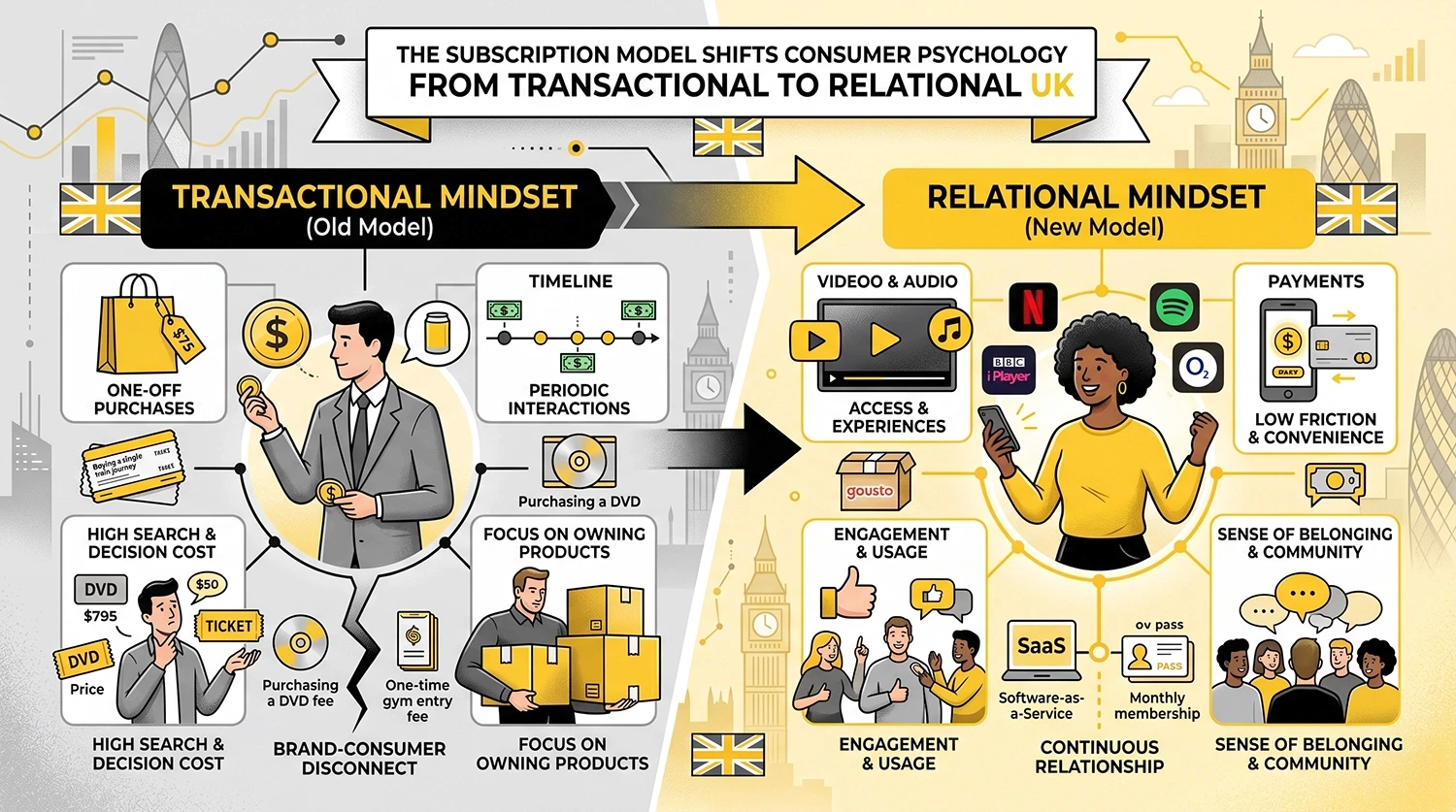
Need to Have vs. Nice to Have
Marketing subscriptions effectively requires understanding whether your offering is a "need to have" (practical, functional) or "nice to have" (emotional, experiential). Counterintuitively, emotional subscriptions can generate stronger loyalty than functional ones when they deliver joy, surprise, and community. A beauty box subscriber who feels personally seen by the curation may be harder to dislodge than a razor refill customer who views the service as interchangeable.
For multicultural marketers, subscriptions connecting with cultural identity operate in the emotional dimension. A monthly box of spices and recipes from a specific region, delivered with cultural stories, becomes a monthly affirmation of identity rather than a mere product delivery.
The UK Subscription Economy at a Glance
Market Growth (2012-2018): Over 300% Consumer Spend (2020): £1.4 billion (Royal Mail) Projected Value (2025): £1.8 billion+ Top Consumer Priorities (McKinsey): High quality, good variety Key Brand Benefits: Predictable revenue, first-party data, loyalty, advocacy Primary Risk: Churn and subscription fatigue Critical Success Factor: Retention through genuine ongoing value
Five Tips for Subscription Success
Be niche, not faddy. Specificity creates community and defensible positioning. A monthly box of organic, vegan dog treats for small breeds occupies a clearer niche than generic pet supplies. Avoid novelty offerings where excitement fades quickly.
Mix it up. Variety sustains engagement. Rotating products, seasonal themes, and limited editions prevent subscriptions from becoming stale. For multicultural offerings, variety can include rotating regional focuses or seasonal cultural celebrations.
Prioritise retention over acquisition. Acquisition costs are front-loaded; profitability depends on sustained tenure. Invest in personalised communication, responsive service, and continuous product improvement.
Make experience effortless. Retention should never rely on making cancellation difficult. Beer52 and ClassPass have faced criticism for punitive exit processes that destroy goodwill. Offer flexible tiers, easy pausing, and frictionless cancellation. The goodwill from an easy exit often produces return subscribers and positive recommendations.
Put data first. Understand spending habits, engagement patterns, sign-up triggers, and churn indicators. For multicultural subscriptions, track cultural preferences, language needs, and calendar-driven consumption patterns.
Multicultural Marketing Implications
The subscription economy presents specific opportunities for engaging the UK's diverse communities. Multicultural audiences are already significant participants in streaming, remittance, and culturally specific content subscriptions. The community dimension of subscriptions aligns with tight-knit social structures where word-of-mouth and family endorsement drive uptake.
First-party data from direct subscription relationships is particularly valuable for multicultural marketers, who have historically struggled to obtain granular insights through generalist research panels. Proprietary data on cultural preferences, consumption timing, and language needs can inform both subscription offerings and broader brand strategy.
Conclusion
The subscription model has evolved from a billing mechanism into a comprehensive loyalty infrastructure. With UK spending approaching £1.8 billion, its viability spans digital services, physical products, education, and countless niches. For multicultural marketers, subscriptions offer direct customer relationships, proprietary data, community alignment, and recurring revenue that supports sustained investment in culturally intelligent offerings.
The principles are clear: be niche but not faddy, prioritise variety and retention, make customer experience effortless including exit, and let data guide every decision. Mediareach's four decades of multicultural expertise provides the foundation for building subscription services that cultivate lasting loyalty across every community your brand serves.
Build Subscription Services That Cultivate Loyalty
Mediareach combines four decades of multicultural expertise with data-driven subscription marketing strategy. Create culturally intelligent subscription experiences that acquire, retain, and advocate across Britain's diverse communities.
Sources & References
Royal Mail, "UK Subscription Box Market Report," 2020. royalmail.com
McKinsey & Company, "Consumer Subscription Research," 2021. mckinsey.com
Subscription Trade Association (SUBTA), "UK Subscription Market Growth Data, 2012-2018." subta.com
Hello Fresh, "Annual Report and Subscription Growth Metrics," 2020. hellofreshgroup.com
Dollar Shave Club, "Unilever Acquisition Case Study," 2016. dollarshaveclub.com
Skillshare, "Subscription Learning Platform Growth," 2021. skillshare.com
MasterClass, "Annual Subscription Metrics," 2021. masterclass.com
Codecademy, "Subscription-Based Education Analysis," 2021. codecademy.com
Zipcar, "Mobility-as-a-Service Model," 2021. zipcar.com
Mediareach Advertising, "Digital Marketing and Customer Retention Strategy," 2021. mediareach.co
subscription services UK
loyalty marketing subscriptions
subscription economy growth
subscription business model UK
first-party data subscriptions
subscription retention strategy
multicultural subscription marketing
SaaS marketing trends
subscription box marketing
customer lifetime value
predictable revenue model
subscription fatigue marketing
McKinsey subscription insights
Royal Mail subscription report
Mediareach loyalty marketing
The UK's pioneering multicultural marketing and advertising agency. Over 40 years connecting brands with diverse communities through cultural insight, creative excellence, and intelligent media strategy. mediareach.co



Sep 20, 2021
The Rise and Benefits of Subscription Services in Loyalty Marketing
Subscription services grew over 300% between 2012 and 2018, with UK consumers spending £1.4 billion by 2020. Here is how the subscription model is reshaping brand loyalty, revenue predictability, and customer relationships.
⏱ 10 min read
By mediareach
How many subscription services are you currently signed up to? It is likely significantly more than ten years ago. Subscription services grew by over 300 percent between 2012 and 2018, transforming from a niche model into a dominant force across virtually every consumer category. According to the Royal Mail, consumers spent almost £1.4 billion on subscription-based deliveries in 2020, with projections estimating the market will reach £1.8 billion by 2025.
For multicultural marketers, this shift carries particular significance. The UK's diverse communities represent both a significant existing subscriber base and an underserved opportunity for brands delivering culturally relevant, personalised subscription experiences.
The Evolution of Subscription Services
Before the internet, subscriptions were limited to newspapers, magazines, and milk deliveries. Since the early 2010s, the model evolved dramatically. Netflix and Spotify pioneered access-over-ownership for entertainment. Physical product companies followed, leveraging social media reach and streamlined online payments to build subscription box services across every category imaginable: recipe boxes like Hello Fresh, grooming products like Dollar Shave Club, and countless niche offerings.
The subscription model taps into powerful behavioural drivers: convenience, the pleasure of regular discovery, community belonging, and the cognitive relief of automated decision-making. Consumers are not merely purchasing products; they are outsourcing consumption categories to trusted curators.
A Win-Win for Consumers and Brands
Subscription services benefit consumers through convenience, cost efficiency, and the emotional reward of regular deliveries. They are often presented as clubs rather than transactions, creating identity and community around membership. For multicultural audiences, this community dimension is particularly potent when subscriptions curate culturally specific products with contextual storytelling.
For brands, the advantages are equally compelling. Subscriptions promote loyalty by design, enable predictable revenue forecasting, and generate invaluable first-party data in an era of diminishing third-party cookies. Research also shows subscribers are more likely to write positive reviews and advocate for brands they engage with regularly, thanks to the mere exposure effect.
"High quality and a good variety of items or experiences are both more important to customers than simply saving money."
McKinsey & Company
Consumer Subscription Research
The Challenges: Churn, Fatigue, and Retention
The subscription model is not without risks. The primary hurdle is communicating genuine value that justifies ongoing commitment. McKinsey research confirms that consumers prioritise quality and variety over cost savings, so brands leading on price alone attract disloyal subscribers.
Churn remains the most significant threat: customers signing up and cancelling, often after trial periods. This erodes the predictability that makes subscriptions attractive and wastes acquisition spend.
More recently, subscription fatigue has emerged as consumers feel overwhelmed by tracking multiple recurring charges. Brands entering this space must offer compelling, evolving value rather than relying on inertia or punitive cancellation friction.
Need to Have vs. Nice to Have
Marketing subscriptions effectively requires understanding whether your offering is a "need to have" (practical, functional) or "nice to have" (emotional, experiential). Counterintuitively, emotional subscriptions can generate stronger loyalty than functional ones when they deliver joy, surprise, and community. A beauty box subscriber who feels personally seen by the curation may be harder to dislodge than a razor refill customer who views the service as interchangeable.
For multicultural marketers, subscriptions connecting with cultural identity operate in the emotional dimension. A monthly box of spices and recipes from a specific region, delivered with cultural stories, becomes a monthly affirmation of identity rather than a mere product delivery.
The UK Subscription Economy at a Glance
Market Growth (2012-2018): Over 300% Consumer Spend (2020): £1.4 billion (Royal Mail) Projected Value (2025): £1.8 billion+ Top Consumer Priorities (McKinsey): High quality, good variety Key Brand Benefits: Predictable revenue, first-party data, loyalty, advocacy Primary Risk: Churn and subscription fatigue Critical Success Factor: Retention through genuine ongoing value
Five Tips for Subscription Success
Be niche, not faddy. Specificity creates community and defensible positioning. A monthly box of organic, vegan dog treats for small breeds occupies a clearer niche than generic pet supplies. Avoid novelty offerings where excitement fades quickly.
Mix it up. Variety sustains engagement. Rotating products, seasonal themes, and limited editions prevent subscriptions from becoming stale. For multicultural offerings, variety can include rotating regional focuses or seasonal cultural celebrations.
Prioritise retention over acquisition. Acquisition costs are front-loaded; profitability depends on sustained tenure. Invest in personalised communication, responsive service, and continuous product improvement.
Make experience effortless. Retention should never rely on making cancellation difficult. Beer52 and ClassPass have faced criticism for punitive exit processes that destroy goodwill. Offer flexible tiers, easy pausing, and frictionless cancellation. The goodwill from an easy exit often produces return subscribers and positive recommendations.
Put data first. Understand spending habits, engagement patterns, sign-up triggers, and churn indicators. For multicultural subscriptions, track cultural preferences, language needs, and calendar-driven consumption patterns.
Multicultural Marketing Implications
The subscription economy presents specific opportunities for engaging the UK's diverse communities. Multicultural audiences are already significant participants in streaming, remittance, and culturally specific content subscriptions. The community dimension of subscriptions aligns with tight-knit social structures where word-of-mouth and family endorsement drive uptake.
First-party data from direct subscription relationships is particularly valuable for multicultural marketers, who have historically struggled to obtain granular insights through generalist research panels. Proprietary data on cultural preferences, consumption timing, and language needs can inform both subscription offerings and broader brand strategy.
Conclusion
The subscription model has evolved from a billing mechanism into a comprehensive loyalty infrastructure. With UK spending approaching £1.8 billion, its viability spans digital services, physical products, education, and countless niches. For multicultural marketers, subscriptions offer direct customer relationships, proprietary data, community alignment, and recurring revenue that supports sustained investment in culturally intelligent offerings.
The principles are clear: be niche but not faddy, prioritise variety and retention, make customer experience effortless including exit, and let data guide every decision. Mediareach's four decades of multicultural expertise provides the foundation for building subscription services that cultivate lasting loyalty across every community your brand serves.
Build Subscription Services That Cultivate Loyalty
Mediareach combines four decades of multicultural expertise with data-driven subscription marketing strategy. Create culturally intelligent subscription experiences that acquire, retain, and advocate across Britain's diverse communities.
Sources & References
Royal Mail, "UK Subscription Box Market Report," 2020. royalmail.com
McKinsey & Company, "Consumer Subscription Research," 2021. mckinsey.com
Subscription Trade Association (SUBTA), "UK Subscription Market Growth Data, 2012-2018." subta.com
Hello Fresh, "Annual Report and Subscription Growth Metrics," 2020. hellofreshgroup.com
Dollar Shave Club, "Unilever Acquisition Case Study," 2016. dollarshaveclub.com
Skillshare, "Subscription Learning Platform Growth," 2021. skillshare.com
MasterClass, "Annual Subscription Metrics," 2021. masterclass.com
Codecademy, "Subscription-Based Education Analysis," 2021. codecademy.com
Zipcar, "Mobility-as-a-Service Model," 2021. zipcar.com
Mediareach Advertising, "Digital Marketing and Customer Retention Strategy," 2021. mediareach.co
subscription services UK
loyalty marketing subscriptions
subscription economy growth
subscription business model UK
first-party data subscriptions
subscription retention strategy
multicultural subscription marketing
SaaS marketing trends
subscription box marketing
customer lifetime value
predictable revenue model
subscription fatigue marketing
McKinsey subscription insights
Royal Mail subscription report
Mediareach loyalty marketing
The UK's pioneering multicultural marketing and advertising agency. Over 40 years connecting brands with diverse communities through cultural insight, creative excellence, and intelligent media strategy. mediareach.co
Sep 20, 2021
The Rise and Benefits of Subscription Services in Loyalty Marketing
Subscription services grew over 300% between 2012 and 2018, with UK consumers spending £1.4 billion by 2020. Here is how the subscription model is reshaping brand loyalty, revenue predictability, and customer relationships.
⏱ 10 min read
By mediareach
How many subscription services are you currently signed up to? It is likely significantly more than ten years ago. Subscription services grew by over 300 percent between 2012 and 2018, transforming from a niche model into a dominant force across virtually every consumer category. According to the Royal Mail, consumers spent almost £1.4 billion on subscription-based deliveries in 2020, with projections estimating the market will reach £1.8 billion by 2025.
For multicultural marketers, this shift carries particular significance. The UK's diverse communities represent both a significant existing subscriber base and an underserved opportunity for brands delivering culturally relevant, personalised subscription experiences.
The Evolution of Subscription Services
Before the internet, subscriptions were limited to newspapers, magazines, and milk deliveries. Since the early 2010s, the model evolved dramatically. Netflix and Spotify pioneered access-over-ownership for entertainment. Physical product companies followed, leveraging social media reach and streamlined online payments to build subscription box services across every category imaginable: recipe boxes like Hello Fresh, grooming products like Dollar Shave Club, and countless niche offerings.
The subscription model taps into powerful behavioural drivers: convenience, the pleasure of regular discovery, community belonging, and the cognitive relief of automated decision-making. Consumers are not merely purchasing products; they are outsourcing consumption categories to trusted curators.
A Win-Win for Consumers and Brands
Subscription services benefit consumers through convenience, cost efficiency, and the emotional reward of regular deliveries. They are often presented as clubs rather than transactions, creating identity and community around membership. For multicultural audiences, this community dimension is particularly potent when subscriptions curate culturally specific products with contextual storytelling.
For brands, the advantages are equally compelling. Subscriptions promote loyalty by design, enable predictable revenue forecasting, and generate invaluable first-party data in an era of diminishing third-party cookies. Research also shows subscribers are more likely to write positive reviews and advocate for brands they engage with regularly, thanks to the mere exposure effect.
"High quality and a good variety of items or experiences are both more important to customers than simply saving money."
McKinsey & Company
Consumer Subscription Research
The Challenges: Churn, Fatigue, and Retention
The subscription model is not without risks. The primary hurdle is communicating genuine value that justifies ongoing commitment. McKinsey research confirms that consumers prioritise quality and variety over cost savings, so brands leading on price alone attract disloyal subscribers.
Churn remains the most significant threat: customers signing up and cancelling, often after trial periods. This erodes the predictability that makes subscriptions attractive and wastes acquisition spend.
More recently, subscription fatigue has emerged as consumers feel overwhelmed by tracking multiple recurring charges. Brands entering this space must offer compelling, evolving value rather than relying on inertia or punitive cancellation friction.
Need to Have vs. Nice to Have
Marketing subscriptions effectively requires understanding whether your offering is a "need to have" (practical, functional) or "nice to have" (emotional, experiential). Counterintuitively, emotional subscriptions can generate stronger loyalty than functional ones when they deliver joy, surprise, and community. A beauty box subscriber who feels personally seen by the curation may be harder to dislodge than a razor refill customer who views the service as interchangeable.
For multicultural marketers, subscriptions connecting with cultural identity operate in the emotional dimension. A monthly box of spices and recipes from a specific region, delivered with cultural stories, becomes a monthly affirmation of identity rather than a mere product delivery.
The UK Subscription Economy at a Glance
Market Growth (2012-2018): Over 300% Consumer Spend (2020): £1.4 billion (Royal Mail) Projected Value (2025): £1.8 billion+ Top Consumer Priorities (McKinsey): High quality, good variety Key Brand Benefits: Predictable revenue, first-party data, loyalty, advocacy Primary Risk: Churn and subscription fatigue Critical Success Factor: Retention through genuine ongoing value
Five Tips for Subscription Success
Be niche, not faddy. Specificity creates community and defensible positioning. A monthly box of organic, vegan dog treats for small breeds occupies a clearer niche than generic pet supplies. Avoid novelty offerings where excitement fades quickly.
Mix it up. Variety sustains engagement. Rotating products, seasonal themes, and limited editions prevent subscriptions from becoming stale. For multicultural offerings, variety can include rotating regional focuses or seasonal cultural celebrations.
Prioritise retention over acquisition. Acquisition costs are front-loaded; profitability depends on sustained tenure. Invest in personalised communication, responsive service, and continuous product improvement.
Make experience effortless. Retention should never rely on making cancellation difficult. Beer52 and ClassPass have faced criticism for punitive exit processes that destroy goodwill. Offer flexible tiers, easy pausing, and frictionless cancellation. The goodwill from an easy exit often produces return subscribers and positive recommendations.
Put data first. Understand spending habits, engagement patterns, sign-up triggers, and churn indicators. For multicultural subscriptions, track cultural preferences, language needs, and calendar-driven consumption patterns.
Multicultural Marketing Implications
The subscription economy presents specific opportunities for engaging the UK's diverse communities. Multicultural audiences are already significant participants in streaming, remittance, and culturally specific content subscriptions. The community dimension of subscriptions aligns with tight-knit social structures where word-of-mouth and family endorsement drive uptake.
First-party data from direct subscription relationships is particularly valuable for multicultural marketers, who have historically struggled to obtain granular insights through generalist research panels. Proprietary data on cultural preferences, consumption timing, and language needs can inform both subscription offerings and broader brand strategy.
Conclusion
The subscription model has evolved from a billing mechanism into a comprehensive loyalty infrastructure. With UK spending approaching £1.8 billion, its viability spans digital services, physical products, education, and countless niches. For multicultural marketers, subscriptions offer direct customer relationships, proprietary data, community alignment, and recurring revenue that supports sustained investment in culturally intelligent offerings.
The principles are clear: be niche but not faddy, prioritise variety and retention, make customer experience effortless including exit, and let data guide every decision. Mediareach's four decades of multicultural expertise provides the foundation for building subscription services that cultivate lasting loyalty across every community your brand serves.
Build Subscription Services That Cultivate Loyalty
Mediareach combines four decades of multicultural expertise with data-driven subscription marketing strategy. Create culturally intelligent subscription experiences that acquire, retain, and advocate across Britain's diverse communities.
Sources & References
Royal Mail, "UK Subscription Box Market Report," 2020. royalmail.com
McKinsey & Company, "Consumer Subscription Research," 2021. mckinsey.com
Subscription Trade Association (SUBTA), "UK Subscription Market Growth Data, 2012-2018." subta.com
Hello Fresh, "Annual Report and Subscription Growth Metrics," 2020. hellofreshgroup.com
Dollar Shave Club, "Unilever Acquisition Case Study," 2016. dollarshaveclub.com
Skillshare, "Subscription Learning Platform Growth," 2021. skillshare.com
MasterClass, "Annual Subscription Metrics," 2021. masterclass.com
Codecademy, "Subscription-Based Education Analysis," 2021. codecademy.com
Zipcar, "Mobility-as-a-Service Model," 2021. zipcar.com
Mediareach Advertising, "Digital Marketing and Customer Retention Strategy," 2021. mediareach.co
subscription services UK
loyalty marketing subscriptions
subscription economy growth
subscription business model UK
first-party data subscriptions
subscription retention strategy
multicultural subscription marketing
SaaS marketing trends
subscription box marketing
customer lifetime value
predictable revenue model
subscription fatigue marketing
McKinsey subscription insights
Royal Mail subscription report
Mediareach loyalty marketing
The UK's pioneering multicultural marketing and advertising agency. Over 40 years connecting brands with diverse communities through cultural insight, creative excellence, and intelligent media strategy. mediareach.co