
Jul 20, 2020
How Pop-Ups Enhance Experiential Marketing Campaigns
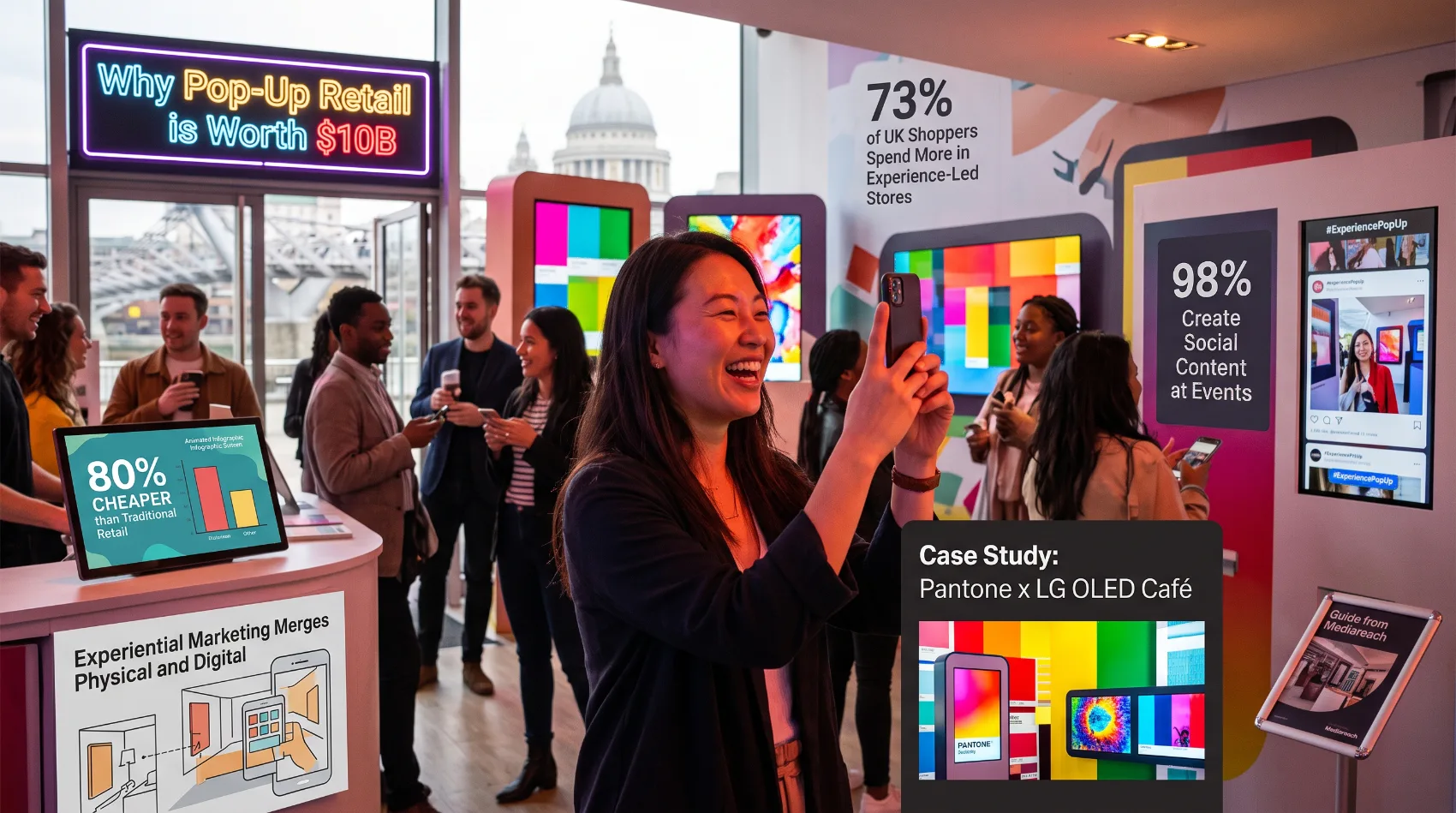
Pop-ups are here to stay — an $10B industry that is 80% cheaper than traditional retail and built to turn physical moments into shareable digital advocacy.
Pop-up shops are here to stay. Well, maybe not literally, and that's exactly why they work.
In an era where experience beats possession, pop-ups have proven to be one of the most effective ways to generate awareness both in-person and through social media, while creating memorable experiences worth sharing.
According to PopUp Republic, the pop-up industry generated $10 billion in sales revenue in 2018 alone. For brands, the appeal is clear: turn shoppers into vocal advocates by giving them something exclusive, temporary and inherently shareable.

Why Pop-Ups Work: Exclusivity Meets Experience
Customers are attracted to exclusivity. The ‘here today, gone tomorrow’ concept creates urgency that traditional retail can't replicate. Millennials, whose annual spending is projected to reach $1.4 trillion and account for 30% of total retail sales by the end of 2020, gravitate towards experiences over products. Pop-ups capitalise on just that.
$10B
Pop-Up Industry Sales 2018 (PopUp Republic)
80%
Cheaper Than Traditional Retail (Shopify)
73%
UK Shoppers Spend More In Experiential Stores (RetailExpo)
$1.4T
Millennial Spending Power by 2020
According to RetailExpo, 73% of UK shoppers would spend more time and money in stores that offer experiences. Over half of survey respondents in the United States said they have shopped at pop-up shops specifically to find unique products and because they offer unique experiences, according to Statista.
And there's a commercial kicker: pop-ups are about 80% less expensive than traditional physical retail outlets, according to Shopify. That makes them a cost-effective strategy to launch new products, run flexible market testing, test pricing and messaging, and even enter new geographic or cultural markets without a long-term lease.


Case Study: Pantone Café x LG OLED — Tasting Colour
LG OLED TVs deliver over a billion rich, accurate colours. Pantone is dedicated to opening up the world to the power of colour. Together, they created Café OLED, where billion-plus colours on screen were matched with colourful artisan pastries and lattes, allowing consumers to see and taste colour in a completely new way.
"LG OLED TVs deliver over a billion rich, accurate colours so partnering with the Pantone Color Institute, an organization that is dedicated to opening up the world to the power of colour, is a perfect colour match," explained Michelle Fernandez, who oversees brand marketing initiatives for LG in the US.
"We do enjoy many different types of collaborations across a wide variety of industries," said Pantone Color Institute VP Laurie Pressman. The café was designed to humanise Pantone's Summer 2019 colours, bringing an emotional connection into both the physical and digital space, enabling the exploration of colour psychology and distilling the relationship between colour and the senses.
The result: visitors didn't just learn about colour trends — they felt them, photographed them and shared them. Press coverage, influencer content and social sharing turned a 3-day physical activation into months of digital value.
How a 3-Day Café Turned Colour Psychology into an Emotional Experience
LG Electronics and the Pantone Color Institute teamed up for a unique 3-day pop-up café to celebrate trending summer colours, in the heart of New York City's art district. It remains a benchmark for bringing content to life.
How to Bring Your Content to Life with Pop-Ups
1. Design for Documentation
Build Instagrammable moments, tactile interactions and sensory details into the space from day one. If 98% of people will create content, give them something worth creating.
2. Test and Learn Without Heavy Risk
Use pop-ups to test new markets, for example, a world foods range in Birmingham or Bradford, or modest fashion in East London, before committing to permanent retail. Collect first-party data and community feedback in real time.
3. Merge Offline and Online Seamlessly
Link the physical experience to a digital action: QR codes to exclusive drops, WhatsApp groups for community recipes, or UGC contests that extend reach into diaspora networks. The goal is conversation and action, not just footfall.
Ready to Bring Your Content to Life?
Mediareach creates engagement, experiential and outreach campaigns that leave a lasting impression — from face-to-face marketing and sampling to roadshows, product launches and pop-up activations across multicultural Britain.
Sources & References
PopUp Republic, "Pop-Up Industry $10B Sales Revenue 2018". popuprepublic.com
MyTotalRetail / TotalRetail, "Millennial Spending $1.4 Trillion by 2020, 30% of retail". mytotalretail.com
RetailExpo / Retail Times, "73% of UK shoppers would spend more in experiential stores". retailtimes.co.uk
Statista Survey US — Over half shop pop-ups for unique products/experiences. statista.com
Shopify, "Pop-ups 80% less expensive than traditional retail". shopify.com
Event Marketer Event Tracking Study — 98% create content at events, 75% more likely to buy after friends' posts. eventmarketer.com
Adweek / Pantone Color Institute x LG Electronics, "Pantone Café OLED 3-day pop-up NYC". adweek.com
pop-up retail
experiential marketing
pop-up shops UK
bringing content to life
pop-up industry $10B
experiential retail stats
Pantone Café LG OLED
Millennial experiential retail
retail activation
pop-up 80% cheaper
98% create social content
experiential agency London
multicultural experiential marketing
The UK's pioneering multicultural marketing and advertising agency. Over 40 years connecting brands with diverse communities through cultural insight, creative excellence, and intelligent media strategy. mediareach.co
Jul 20, 2020
How Pop-Ups Enhance Experiential Marketing Campaigns
Pop-ups are here to stay — an $10B industry that is 80% cheaper than traditional retail and built to turn physical moments into shareable digital advocacy.
Pop-up shops are here to stay. Well, maybe not literally, and that's exactly why they work.
In an era where experience beats possession, pop-ups have proven to be one of the most effective ways to generate awareness both in-person and through social media, while creating memorable experiences worth sharing.
According to PopUp Republic, the pop-up industry generated $10 billion in sales revenue in 2018 alone. For brands, the appeal is clear: turn shoppers into vocal advocates by giving them something exclusive, temporary and inherently shareable.
Why Pop-Ups Work: Exclusivity Meets Experience
Customers are attracted to exclusivity. The ‘here today, gone tomorrow’ concept creates urgency that traditional retail can't replicate. Millennials, whose annual spending is projected to reach $1.4 trillion and account for 30% of total retail sales by the end of 2020, gravitate towards experiences over products. Pop-ups capitalise on just that.
$10B
Pop-Up Industry Sales 2018 (PopUp Republic)
80%
Cheaper Than Traditional Retail (Shopify)
73%
UK Shoppers Spend More In Experiential Stores (RetailExpo)
$1.4T
Millennial Spending Power by 2020
According to RetailExpo, 73% of UK shoppers would spend more time and money in stores that offer experiences. Over half of survey respondents in the United States said they have shopped at pop-up shops specifically to find unique products and because they offer unique experiences, according to Statista.
And there's a commercial kicker: pop-ups are about 80% less expensive than traditional physical retail outlets, according to Shopify. That makes them a cost-effective strategy to launch new products, run flexible market testing, test pricing and messaging, and even enter new geographic or cultural markets without a long-term lease.
Case Study: Pantone Café x LG OLED — Tasting Colour
LG OLED TVs deliver over a billion rich, accurate colours. Pantone is dedicated to opening up the world to the power of colour. Together, they created Café OLED, where billion-plus colours on screen were matched with colourful artisan pastries and lattes, allowing consumers to see and taste colour in a completely new way.
"LG OLED TVs deliver over a billion rich, accurate colours so partnering with the Pantone Color Institute, an organization that is dedicated to opening up the world to the power of colour, is a perfect colour match," explained Michelle Fernandez, who oversees brand marketing initiatives for LG in the US.
"We do enjoy many different types of collaborations across a wide variety of industries," said Pantone Color Institute VP Laurie Pressman. The café was designed to humanise Pantone's Summer 2019 colours, bringing an emotional connection into both the physical and digital space, enabling the exploration of colour psychology and distilling the relationship between colour and the senses.
The result: visitors didn't just learn about colour trends — they felt them, photographed them and shared them. Press coverage, influencer content and social sharing turned a 3-day physical activation into months of digital value.
How a 3-Day Café Turned Colour Psychology into an Emotional Experience
LG Electronics and the Pantone Color Institute teamed up for a unique 3-day pop-up café to celebrate trending summer colours, in the heart of New York City's art district. It remains a benchmark for bringing content to life.
How to Bring Your Content to Life with Pop-Ups
1. Design for Documentation
Build Instagrammable moments, tactile interactions and sensory details into the space from day one. If 98% of people will create content, give them something worth creating.
2. Test and Learn Without Heavy Risk
Use pop-ups to test new markets, for example, a world foods range in Birmingham or Bradford, or modest fashion in East London, before committing to permanent retail. Collect first-party data and community feedback in real time.
3. Merge Offline and Online Seamlessly
Link the physical experience to a digital action: QR codes to exclusive drops, WhatsApp groups for community recipes, or UGC contests that extend reach into diaspora networks. The goal is conversation and action, not just footfall.
Ready to Bring Your Content to Life?
Mediareach creates engagement, experiential and outreach campaigns that leave a lasting impression — from face-to-face marketing and sampling to roadshows, product launches and pop-up activations across multicultural Britain.
Sources & References
PopUp Republic, "Pop-Up Industry $10B Sales Revenue 2018". popuprepublic.com
MyTotalRetail / TotalRetail, "Millennial Spending $1.4 Trillion by 2020, 30% of retail". mytotalretail.com
RetailExpo / Retail Times, "73% of UK shoppers would spend more in experiential stores". retailtimes.co.uk
Statista Survey US — Over half shop pop-ups for unique products/experiences. statista.com
Shopify, "Pop-ups 80% less expensive than traditional retail". shopify.com
Event Marketer Event Tracking Study — 98% create content at events, 75% more likely to buy after friends' posts. eventmarketer.com
Adweek / Pantone Color Institute x LG Electronics, "Pantone Café OLED 3-day pop-up NYC". adweek.com
pop-up retail
experiential marketing
pop-up shops UK
bringing content to life
pop-up industry $10B
experiential retail stats
Pantone Café LG OLED
Millennial experiential retail
retail activation
pop-up 80% cheaper
98% create social content
experiential agency London
multicultural experiential marketing
The UK's pioneering multicultural marketing and advertising agency. Over 40 years connecting brands with diverse communities through cultural insight, creative excellence, and intelligent media strategy. mediareach.co
Jul 20, 2020
How Pop-Ups Enhance Experiential Marketing Campaigns
Pop-ups are here to stay — an $10B industry that is 80% cheaper than traditional retail and built to turn physical moments into shareable digital advocacy.
Pop-up shops are here to stay. Well, maybe not literally, and that's exactly why they work.
In an era where experience beats possession, pop-ups have proven to be one of the most effective ways to generate awareness both in-person and through social media, while creating memorable experiences worth sharing.
According to PopUp Republic, the pop-up industry generated $10 billion in sales revenue in 2018 alone. For brands, the appeal is clear: turn shoppers into vocal advocates by giving them something exclusive, temporary and inherently shareable.
Why Pop-Ups Work: Exclusivity Meets Experience
Customers are attracted to exclusivity. The ‘here today, gone tomorrow’ concept creates urgency that traditional retail can't replicate. Millennials, whose annual spending is projected to reach $1.4 trillion and account for 30% of total retail sales by the end of 2020, gravitate towards experiences over products. Pop-ups capitalise on just that.
$10B
Pop-Up Industry Sales 2018 (PopUp Republic)
80%
Cheaper Than Traditional Retail (Shopify)
73%
UK Shoppers Spend More In Experiential Stores (RetailExpo)
$1.4T
Millennial Spending Power by 2020
According to RetailExpo, 73% of UK shoppers would spend more time and money in stores that offer experiences. Over half of survey respondents in the United States said they have shopped at pop-up shops specifically to find unique products and because they offer unique experiences, according to Statista.
And there's a commercial kicker: pop-ups are about 80% less expensive than traditional physical retail outlets, according to Shopify. That makes them a cost-effective strategy to launch new products, run flexible market testing, test pricing and messaging, and even enter new geographic or cultural markets without a long-term lease.
Case Study: Pantone Café x LG OLED — Tasting Colour
LG OLED TVs deliver over a billion rich, accurate colours. Pantone is dedicated to opening up the world to the power of colour. Together, they created Café OLED, where billion-plus colours on screen were matched with colourful artisan pastries and lattes, allowing consumers to see and taste colour in a completely new way.
"LG OLED TVs deliver over a billion rich, accurate colours so partnering with the Pantone Color Institute, an organization that is dedicated to opening up the world to the power of colour, is a perfect colour match," explained Michelle Fernandez, who oversees brand marketing initiatives for LG in the US.
"We do enjoy many different types of collaborations across a wide variety of industries," said Pantone Color Institute VP Laurie Pressman. The café was designed to humanise Pantone's Summer 2019 colours, bringing an emotional connection into both the physical and digital space, enabling the exploration of colour psychology and distilling the relationship between colour and the senses.
The result: visitors didn't just learn about colour trends — they felt them, photographed them and shared them. Press coverage, influencer content and social sharing turned a 3-day physical activation into months of digital value.
How a 3-Day Café Turned Colour Psychology into an Emotional Experience
LG Electronics and the Pantone Color Institute teamed up for a unique 3-day pop-up café to celebrate trending summer colours, in the heart of New York City's art district. It remains a benchmark for bringing content to life.
How to Bring Your Content to Life with Pop-Ups
1. Design for Documentation
Build Instagrammable moments, tactile interactions and sensory details into the space from day one. If 98% of people will create content, give them something worth creating.
2. Test and Learn Without Heavy Risk
Use pop-ups to test new markets, for example, a world foods range in Birmingham or Bradford, or modest fashion in East London, before committing to permanent retail. Collect first-party data and community feedback in real time.
3. Merge Offline and Online Seamlessly
Link the physical experience to a digital action: QR codes to exclusive drops, WhatsApp groups for community recipes, or UGC contests that extend reach into diaspora networks. The goal is conversation and action, not just footfall.
Ready to Bring Your Content to Life?
Mediareach creates engagement, experiential and outreach campaigns that leave a lasting impression — from face-to-face marketing and sampling to roadshows, product launches and pop-up activations across multicultural Britain.
Sources & References
PopUp Republic, "Pop-Up Industry $10B Sales Revenue 2018". popuprepublic.com
MyTotalRetail / TotalRetail, "Millennial Spending $1.4 Trillion by 2020, 30% of retail". mytotalretail.com
RetailExpo / Retail Times, "73% of UK shoppers would spend more in experiential stores". retailtimes.co.uk
Statista Survey US — Over half shop pop-ups for unique products/experiences. statista.com
Shopify, "Pop-ups 80% less expensive than traditional retail". shopify.com
Event Marketer Event Tracking Study — 98% create content at events, 75% more likely to buy after friends' posts. eventmarketer.com
Adweek / Pantone Color Institute x LG Electronics, "Pantone Café OLED 3-day pop-up NYC". adweek.com
pop-up retail
experiential marketing
pop-up shops UK
bringing content to life
pop-up industry $10B
experiential retail stats
Pantone Café LG OLED
Millennial experiential retail
retail activation
pop-up 80% cheaper
98% create social content
experiential agency London
multicultural experiential marketing
The UK's pioneering multicultural marketing and advertising agency. Over 40 years connecting brands with diverse communities through cultural insight, creative excellence, and intelligent media strategy. mediareach.co