
Aug 27, 2026
Why Mother's Day 2026 Is a £1.6 Billion Opportunity for UK Brands
⏱ 3 min read
By mediareach
UK retail spending for Mother's Day hit £1.6 billion in 2024, up from £1.28 billion the year before. In 2026, 57% of UK consumers intend to buy at least one item, with average spending around £50 per person. For brands, this is not merely a calendar event. It is a concentrated window of emotional purchasing power that rewards preparation, cultural intelligence, and precise targeting.
Mother's Day in the UK falls on the fourth Sunday of Lent, 15 March in 2026. Unlike the fixed-date US observance in May, the UK date shifts with the lunar calendar, which means marketing timelines must be planned around Easter. Brands that treat Mothering Sunday as an afterthought to Valentine's Day miss the structural opportunity: it is the third most celebrated retail occasion in the UK calendar, behind only Christmas and Easter.
The 2026 Consumer Landscape
The post-pandemic shift toward at-home celebration has stuck. Seven in ten shoppers expect to celebrate with a meal at home this year, driven partly by the rising cost of dining out and partly by retailers' increasingly sophisticated meal-deal offerings. Supermarkets and grocers are the clear beneficiaries, but only if they promote premium own-label ranges and luxury desserts that feel special without the restaurant price tag.
Gift categories are evolving. Flowers remain the default, florists see a 553% spike in transactions on the Friday before Mother's Day, but consumers are moving beyond predictable defaults. 58% of shoppers expect to buy a customised or personalised gift. Social media is now the primary discovery channel: 52% of shoppers spot gift ideas on social platforms, with short-form video on TikTok and Instagram Reels influencing 34% of decisions overall, and 57% among families with young children. Brands that are not visible in these discovery environments are invisible to the next generation of gift-givers.
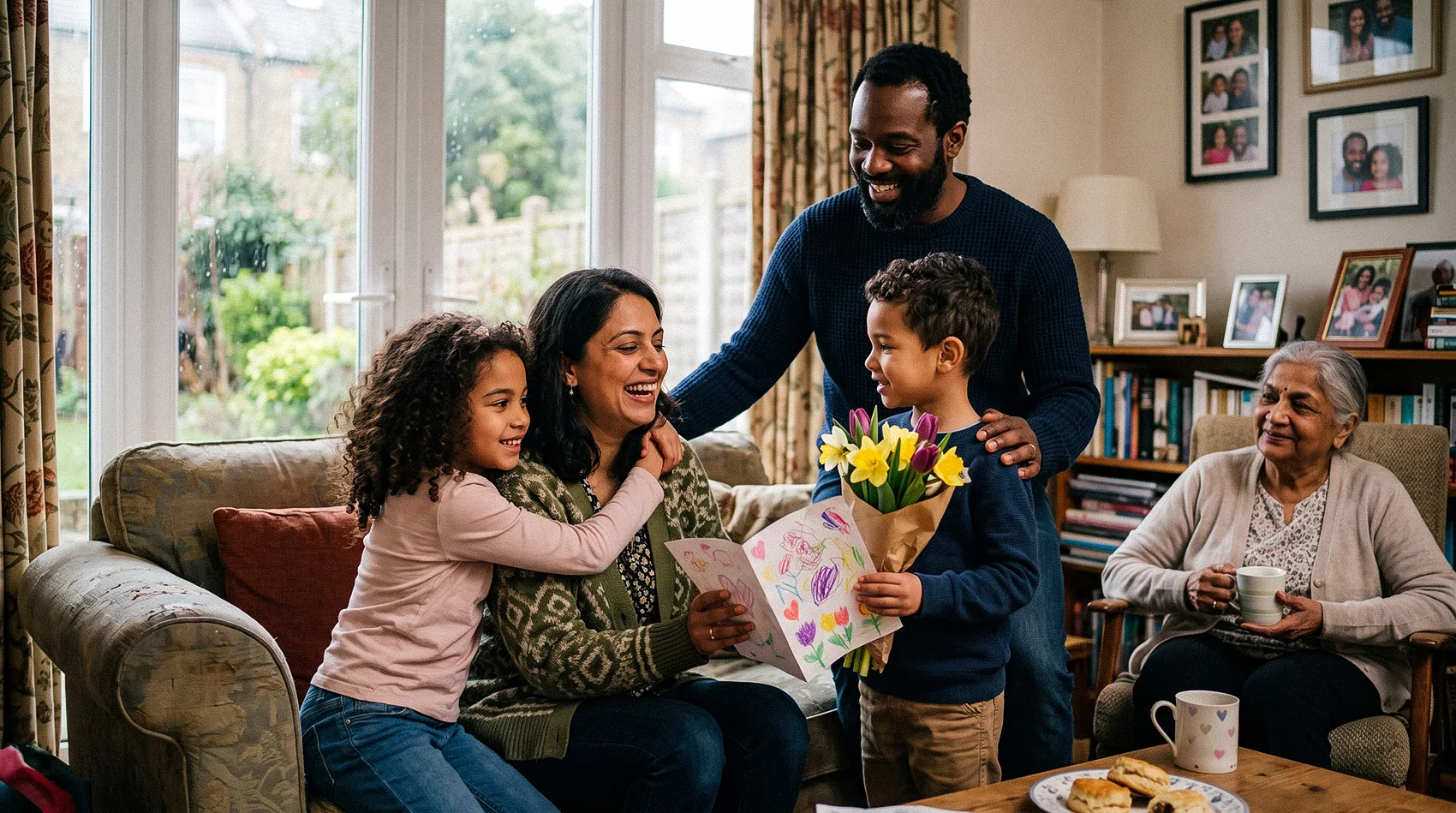
The Multicultural Opportunity
Here is where most Mother's Day campaigns fall short. The UK is home to communities with profoundly different relationships to motherhood, gift-giving, and celebration. A one-size-fits-all campaign featuring a white nuclear family exchanging chocolates and flowers misses vast swathes of the market.
British South Asian families often celebrate with multi-generational gatherings and elaborate home-cooked meals. The gift is frequently an experience, a family outing or a shared meal, rather than a wrapped object. British Caribbean communities may emphasise church attendance, music, and communal celebration. British African families often blend traditional respect for elders with contemporary gifting, while British Polish and Romanian communities bring their own Mothering Sunday customs from countries where the observance carries deep religious significance.
For marketers, the implication is practical. Casting must reflect the UK's actual family structures, blended, multi-generational, and cross-cultural. Messaging must avoid assumptions about who "counts" as a mother: stepmothers, foster mothers, aunts who raised children, and grandmothers all occupy maternal roles in different communities. 81% of mothers say they want a gift that feels personal or thoughtful; cultural recognition is one of the fastest routes to that feeling.
Mother's Day 2026 at a Glance
Date: Sunday, 15 March 2026 (4th Sunday of Lent) UK Retail Spend: £1.6 billion in 2024, up from £1.28 billion in 2023 Participation: 57% of consumers intend to buy at least one item Average Spend: Around £50 per person Top Gifts: Flowers (74%), greeting cards (73%), special outings (61%) At-Home Celebration: 70% of shoppers plan a home meal Social Discovery: 52% spot ideas on social media; 34% influenced by short-form video Personalisation: 58% expect to buy a customised gift What Moms Want Most: A handwritten card (50%), a thoughtful gift (81%)
What Smart Brands Do Differently
The most effective Mother's Day campaigns share three characteristics: they start early, they lead with emotion, and they respect the audience's intelligence.
Start six weeks out.
The highest-value purchases are planned, not impulse. Brands that launch awareness campaigns in early February, particularly on ethnic media channels where community conversation happens ahead of mainstream advertising, capture attention before competitors enter the frame.
Lead with emotion, not discounts.
Tesco's #EveryMum campaign succeeded because it featured real people, stepmoms, foster moms, biological moms, aunts, rather than actors playing idealised versions of motherhood. Dove's #RealMoms campaign deliberately broke away from polished perfection to show single moms, farm moms, and transgender mothers. The result is not just feel-good marketing. It is commercial differentiation in a crowded category.
Speak to the self-gifting mom.
Data Axle found that 45% of single mothers purchased a gift for themselves on Mother's Day. "Treat yourself" messaging does not exclude gift-givers, it often inspires them. Smart brands create messaging that works for both audiences simultaneously.
Conclusion: Culture Is the Competitive Edge
Mother's Day is not a generic retail occasion. It is a culturally specific, emotionally charged moment that varies dramatically across the UK's diverse communities. Brands that recognise this, that invest in casting, messaging, and channel selection that reflects real British families, outperform those that default to stock imagery and one-size-fits-all promotions.
With 63% of shoppers saying they would spend more if retailers offered more interesting gift options, the growth potential is substantial. The brands that unlock it will be those that understand who they are talking to, what those mothers actually value, and how to reach them through the media channels they trust. Mother's Day is a test of cultural intelligence. The brands that pass it reap the rewards.

Make Mother's Day Matter to Every Community
Mediareach brings four decades of multicultural marketing expertise to seasonal campaigns. From culturally intelligent creative to precision media planning, we help brands connect with Britain's diverse families.
Sources & References
Mintel, "UK Mother's Day Market Report 2026," July 2026. mintel.com
GlobalData, "Retail Occasions Series: UK Mother's Day Intentions 2026," March 2026. globaldata.com
Barclays, "Mother's Day 2025 Spending: UK Unlocked," April 2025. home.barclays
Experian, "Celebrate Mum: Your Guide to Mother's Day Audiences," February 2025. experian.co.uk
Playable, "Mother's Day Marketing: Insights and Ideas for 2026," March 2026. playable.com
Trusted Shops, "Mother's Day Marketing Tips for Online Shops," March 2026. trustedshops.com
Drive Research, "Mother's Day Statistics 2026," April 2026. driveresearch.com
BBC, "When is Mother's Day 2026 and why do we celebrate it?" March 2026. bbc.co.uk
Mediareach Advertising, "Multicultural Marketing and Retail Services," 2026. mediareach.co
mothers day marketing UK 2026
mothers day spending statistics UK
multicultural mothers day campaigns
UK retail mothers day
mothering sunday marketing
mothers day consumer behaviour UK
ethnic minority mothers day
mothers day advertising strategy UK
seasonal retail marketing UK
multicultural family marketing
UK mothers day 2026 date
personalised gift marketing UK
social media mothers day campaigns
diverse family representation advertising
UK retail calendar 2026
The UK's pioneering multicultural marketing and advertising agency. Over 40 years connecting brands with diverse communities through cultural insight, creative excellence, and intelligent media strategy. mediareach.co



Aug 27, 2026
Why Mother's Day 2026 Is a £1.6 Billion Opportunity for UK Brands
⏱ 3 min read
By mediareach
UK retail spending for Mother's Day hit £1.6 billion in 2024, up from £1.28 billion the year before. In 2026, 57% of UK consumers intend to buy at least one item, with average spending around £50 per person. For brands, this is not merely a calendar event. It is a concentrated window of emotional purchasing power that rewards preparation, cultural intelligence, and precise targeting.
Mother's Day in the UK falls on the fourth Sunday of Lent, 15 March in 2026. Unlike the fixed-date US observance in May, the UK date shifts with the lunar calendar, which means marketing timelines must be planned around Easter. Brands that treat Mothering Sunday as an afterthought to Valentine's Day miss the structural opportunity: it is the third most celebrated retail occasion in the UK calendar, behind only Christmas and Easter.
The 2026 Consumer Landscape
The post-pandemic shift toward at-home celebration has stuck. Seven in ten shoppers expect to celebrate with a meal at home this year, driven partly by the rising cost of dining out and partly by retailers' increasingly sophisticated meal-deal offerings. Supermarkets and grocers are the clear beneficiaries, but only if they promote premium own-label ranges and luxury desserts that feel special without the restaurant price tag.
Gift categories are evolving. Flowers remain the default, florists see a 553% spike in transactions on the Friday before Mother's Day, but consumers are moving beyond predictable defaults. 58% of shoppers expect to buy a customised or personalised gift. Social media is now the primary discovery channel: 52% of shoppers spot gift ideas on social platforms, with short-form video on TikTok and Instagram Reels influencing 34% of decisions overall, and 57% among families with young children. Brands that are not visible in these discovery environments are invisible to the next generation of gift-givers.
The Multicultural Opportunity
Here is where most Mother's Day campaigns fall short. The UK is home to communities with profoundly different relationships to motherhood, gift-giving, and celebration. A one-size-fits-all campaign featuring a white nuclear family exchanging chocolates and flowers misses vast swathes of the market.
British South Asian families often celebrate with multi-generational gatherings and elaborate home-cooked meals. The gift is frequently an experience, a family outing or a shared meal, rather than a wrapped object. British Caribbean communities may emphasise church attendance, music, and communal celebration. British African families often blend traditional respect for elders with contemporary gifting, while British Polish and Romanian communities bring their own Mothering Sunday customs from countries where the observance carries deep religious significance.
For marketers, the implication is practical. Casting must reflect the UK's actual family structures, blended, multi-generational, and cross-cultural. Messaging must avoid assumptions about who "counts" as a mother: stepmothers, foster mothers, aunts who raised children, and grandmothers all occupy maternal roles in different communities. 81% of mothers say they want a gift that feels personal or thoughtful; cultural recognition is one of the fastest routes to that feeling.
Mother's Day 2026 at a Glance
Date: Sunday, 15 March 2026 (4th Sunday of Lent) UK Retail Spend: £1.6 billion in 2024, up from £1.28 billion in 2023 Participation: 57% of consumers intend to buy at least one item Average Spend: Around £50 per person Top Gifts: Flowers (74%), greeting cards (73%), special outings (61%) At-Home Celebration: 70% of shoppers plan a home meal Social Discovery: 52% spot ideas on social media; 34% influenced by short-form video Personalisation: 58% expect to buy a customised gift What Moms Want Most: A handwritten card (50%), a thoughtful gift (81%)
What Smart Brands Do Differently
The most effective Mother's Day campaigns share three characteristics: they start early, they lead with emotion, and they respect the audience's intelligence.
Start six weeks out.
The highest-value purchases are planned, not impulse. Brands that launch awareness campaigns in early February, particularly on ethnic media channels where community conversation happens ahead of mainstream advertising, capture attention before competitors enter the frame.
Lead with emotion, not discounts.
Tesco's #EveryMum campaign succeeded because it featured real people, stepmoms, foster moms, biological moms, aunts, rather than actors playing idealised versions of motherhood. Dove's #RealMoms campaign deliberately broke away from polished perfection to show single moms, farm moms, and transgender mothers. The result is not just feel-good marketing. It is commercial differentiation in a crowded category.
Speak to the self-gifting mom.
Data Axle found that 45% of single mothers purchased a gift for themselves on Mother's Day. "Treat yourself" messaging does not exclude gift-givers, it often inspires them. Smart brands create messaging that works for both audiences simultaneously.
Conclusion: Culture Is the Competitive Edge
Mother's Day is not a generic retail occasion. It is a culturally specific, emotionally charged moment that varies dramatically across the UK's diverse communities. Brands that recognise this, that invest in casting, messaging, and channel selection that reflects real British families, outperform those that default to stock imagery and one-size-fits-all promotions.
With 63% of shoppers saying they would spend more if retailers offered more interesting gift options, the growth potential is substantial. The brands that unlock it will be those that understand who they are talking to, what those mothers actually value, and how to reach them through the media channels they trust. Mother's Day is a test of cultural intelligence. The brands that pass it reap the rewards.
Make Mother's Day Matter to Every Community
Mediareach brings four decades of multicultural marketing expertise to seasonal campaigns. From culturally intelligent creative to precision media planning, we help brands connect with Britain's diverse families.
Sources & References
Mintel, "UK Mother's Day Market Report 2026," July 2026. mintel.com
GlobalData, "Retail Occasions Series: UK Mother's Day Intentions 2026," March 2026. globaldata.com
Barclays, "Mother's Day 2025 Spending: UK Unlocked," April 2025. home.barclays
Experian, "Celebrate Mum: Your Guide to Mother's Day Audiences," February 2025. experian.co.uk
Playable, "Mother's Day Marketing: Insights and Ideas for 2026," March 2026. playable.com
Trusted Shops, "Mother's Day Marketing Tips for Online Shops," March 2026. trustedshops.com
Drive Research, "Mother's Day Statistics 2026," April 2026. driveresearch.com
BBC, "When is Mother's Day 2026 and why do we celebrate it?" March 2026. bbc.co.uk
Mediareach Advertising, "Multicultural Marketing and Retail Services," 2026. mediareach.co
mothers day marketing UK 2026
mothers day spending statistics UK
multicultural mothers day campaigns
UK retail mothers day
mothering sunday marketing
mothers day consumer behaviour UK
ethnic minority mothers day
mothers day advertising strategy UK
seasonal retail marketing UK
multicultural family marketing
UK mothers day 2026 date
personalised gift marketing UK
social media mothers day campaigns
diverse family representation advertising
UK retail calendar 2026
The UK's pioneering multicultural marketing and advertising agency. Over 40 years connecting brands with diverse communities through cultural insight, creative excellence, and intelligent media strategy. mediareach.co
Aug 27, 2026
Why Mother's Day 2026 Is a £1.6 Billion Opportunity for UK Brands
⏱ 3 min read
By mediareach
UK retail spending for Mother's Day hit £1.6 billion in 2024, up from £1.28 billion the year before. In 2026, 57% of UK consumers intend to buy at least one item, with average spending around £50 per person. For brands, this is not merely a calendar event. It is a concentrated window of emotional purchasing power that rewards preparation, cultural intelligence, and precise targeting.
Mother's Day in the UK falls on the fourth Sunday of Lent, 15 March in 2026. Unlike the fixed-date US observance in May, the UK date shifts with the lunar calendar, which means marketing timelines must be planned around Easter. Brands that treat Mothering Sunday as an afterthought to Valentine's Day miss the structural opportunity: it is the third most celebrated retail occasion in the UK calendar, behind only Christmas and Easter.
The 2026 Consumer Landscape
The post-pandemic shift toward at-home celebration has stuck. Seven in ten shoppers expect to celebrate with a meal at home this year, driven partly by the rising cost of dining out and partly by retailers' increasingly sophisticated meal-deal offerings. Supermarkets and grocers are the clear beneficiaries, but only if they promote premium own-label ranges and luxury desserts that feel special without the restaurant price tag.
Gift categories are evolving. Flowers remain the default, florists see a 553% spike in transactions on the Friday before Mother's Day, but consumers are moving beyond predictable defaults. 58% of shoppers expect to buy a customised or personalised gift. Social media is now the primary discovery channel: 52% of shoppers spot gift ideas on social platforms, with short-form video on TikTok and Instagram Reels influencing 34% of decisions overall, and 57% among families with young children. Brands that are not visible in these discovery environments are invisible to the next generation of gift-givers.
The Multicultural Opportunity
Here is where most Mother's Day campaigns fall short. The UK is home to communities with profoundly different relationships to motherhood, gift-giving, and celebration. A one-size-fits-all campaign featuring a white nuclear family exchanging chocolates and flowers misses vast swathes of the market.
British South Asian families often celebrate with multi-generational gatherings and elaborate home-cooked meals. The gift is frequently an experience, a family outing or a shared meal, rather than a wrapped object. British Caribbean communities may emphasise church attendance, music, and communal celebration. British African families often blend traditional respect for elders with contemporary gifting, while British Polish and Romanian communities bring their own Mothering Sunday customs from countries where the observance carries deep religious significance.
For marketers, the implication is practical. Casting must reflect the UK's actual family structures, blended, multi-generational, and cross-cultural. Messaging must avoid assumptions about who "counts" as a mother: stepmothers, foster mothers, aunts who raised children, and grandmothers all occupy maternal roles in different communities. 81% of mothers say they want a gift that feels personal or thoughtful; cultural recognition is one of the fastest routes to that feeling.
Mother's Day 2026 at a Glance
Date: Sunday, 15 March 2026 (4th Sunday of Lent) UK Retail Spend: £1.6 billion in 2024, up from £1.28 billion in 2023 Participation: 57% of consumers intend to buy at least one item Average Spend: Around £50 per person Top Gifts: Flowers (74%), greeting cards (73%), special outings (61%) At-Home Celebration: 70% of shoppers plan a home meal Social Discovery: 52% spot ideas on social media; 34% influenced by short-form video Personalisation: 58% expect to buy a customised gift What Moms Want Most: A handwritten card (50%), a thoughtful gift (81%)
What Smart Brands Do Differently
The most effective Mother's Day campaigns share three characteristics: they start early, they lead with emotion, and they respect the audience's intelligence.
Start six weeks out.
The highest-value purchases are planned, not impulse. Brands that launch awareness campaigns in early February, particularly on ethnic media channels where community conversation happens ahead of mainstream advertising, capture attention before competitors enter the frame.
Lead with emotion, not discounts.
Tesco's #EveryMum campaign succeeded because it featured real people, stepmoms, foster moms, biological moms, aunts, rather than actors playing idealised versions of motherhood. Dove's #RealMoms campaign deliberately broke away from polished perfection to show single moms, farm moms, and transgender mothers. The result is not just feel-good marketing. It is commercial differentiation in a crowded category.
Speak to the self-gifting mom.
Data Axle found that 45% of single mothers purchased a gift for themselves on Mother's Day. "Treat yourself" messaging does not exclude gift-givers, it often inspires them. Smart brands create messaging that works for both audiences simultaneously.
Conclusion: Culture Is the Competitive Edge
Mother's Day is not a generic retail occasion. It is a culturally specific, emotionally charged moment that varies dramatically across the UK's diverse communities. Brands that recognise this, that invest in casting, messaging, and channel selection that reflects real British families, outperform those that default to stock imagery and one-size-fits-all promotions.
With 63% of shoppers saying they would spend more if retailers offered more interesting gift options, the growth potential is substantial. The brands that unlock it will be those that understand who they are talking to, what those mothers actually value, and how to reach them through the media channels they trust. Mother's Day is a test of cultural intelligence. The brands that pass it reap the rewards.
Make Mother's Day Matter to Every Community
Mediareach brings four decades of multicultural marketing expertise to seasonal campaigns. From culturally intelligent creative to precision media planning, we help brands connect with Britain's diverse families.
Sources & References
Mintel, "UK Mother's Day Market Report 2026," July 2026. mintel.com
GlobalData, "Retail Occasions Series: UK Mother's Day Intentions 2026," March 2026. globaldata.com
Barclays, "Mother's Day 2025 Spending: UK Unlocked," April 2025. home.barclays
Experian, "Celebrate Mum: Your Guide to Mother's Day Audiences," February 2025. experian.co.uk
Playable, "Mother's Day Marketing: Insights and Ideas for 2026," March 2026. playable.com
Trusted Shops, "Mother's Day Marketing Tips for Online Shops," March 2026. trustedshops.com
Drive Research, "Mother's Day Statistics 2026," April 2026. driveresearch.com
BBC, "When is Mother's Day 2026 and why do we celebrate it?" March 2026. bbc.co.uk
Mediareach Advertising, "Multicultural Marketing and Retail Services," 2026. mediareach.co
mothers day marketing UK 2026
mothers day spending statistics UK
multicultural mothers day campaigns
UK retail mothers day
mothering sunday marketing
mothers day consumer behaviour UK
ethnic minority mothers day
mothers day advertising strategy UK
seasonal retail marketing UK
multicultural family marketing
UK mothers day 2026 date
personalised gift marketing UK
social media mothers day campaigns
diverse family representation advertising
UK retail calendar 2026
The UK's pioneering multicultural marketing and advertising agency. Over 40 years connecting brands with diverse communities through cultural insight, creative excellence, and intelligent media strategy. mediareach.co