Jul 21, 2026
ONS 2021 Census: Britain Is More Multicultural Than Ever
Ethnic minorities now make up 18.3% of England and Wales. London is 46.2% diverse. Here is what the data means for brands, and why the one-size-fits-all approach is dead.
⏱ 5 min read
By Mediareach
It is not a surprise any more that the multicultural population is growing fast. For over four decades, Mediareach has been releasing analysis backed by data to bring the attention of UK businesses to this fundamental shift in demographics. The 2021 Census confirms what we have long known: Britain is more multicultural than ever.
According to the Office for National Statistics, the population of England and Wales reached 59.6 million in 2021. The ethnic minority population now stands at 10.9 million people — 18.3% of the total. That is up from 14% in 2011. The ethnic minority population has tripled since 1991, when it stood at just 5.9%. On current trajectories, almost one-third of the population will be ethnically diverse by 2051.
18.3%
of England and Wales population is from an ethnic minority background (2021)
10.9M
people from ethnic minority groups in England and Wales
46.2%
of London residents identify with Asian, Black, Mixed or other ethnic groups
10
London boroughs where ethnic minorities are now the majority (up from 6 in 2011)
The Scale of the Shift
The 2021 Census reveals a country being reshaped by diversity. The White British population fell from 80.5% in 2011 to 74.4% in 2021. The "Other White" group saw the largest proportional increase, reflecting continued European migration. The Black African population grew from approximately 990,000 to nearly 1.5 million. The Mixed ethnic group more than doubled since 2001, now standing at over 1.7 million people.
London remains the most diverse region, with 46.2% of residents identifying with Asian, Black, Mixed, or other ethnic groups. But diversity is not just a London story. In 2021, ten London boroughs had ethnic minority majorities — up from six in 2011. Newham leads at 69.2%, followed by Brent at 65.4% and Redbridge at 65.2%. Beyond the capital, Birmingham, Manchester, Leicester, and Slough all show significant ethnic minority populations that are growing, not plateauing.
"In cities such as London, 46.2% of the population is from an ethnic minority background. The diversity is what defines us more than ever. Cultural media, community messaging and niche marketing is becoming the conduit of the advertisers' in-the-know, who have already spotted the value for money and ROI that others are yet to catch onto."
Mediareach
The Business Case: Why This Matters for Brands
From a business perspective, these facts pose enormous opportunities. Businesses can no longer afford to ignore Britain's multicultural market if they want to strategically grow and increase market share. The UK has one of the most diverse cities in the world, where the ethnic population commands significant disposable income.
A 2022 WPP study, The Consumer Equality Equation, found that ethnic minority groups will account for almost a third of the UK adult population by 2061, with projected annual disposable income of £575 billion. By engaging just 1% of ethnic minority consumers to change their spending habits, brands could tap into a £2.34 billion short-term growth opportunity. The cumulative figure is staggering: up to £16.7 trillion in disposable income by 2061.
Consumer expectations have shifted decisively. The same WPP study found that 83% of all UK consumers believe brands should make more effort to understand different ethnic groups. 77% of ethnic minority consumers actively choose brands with a strong social purpose. When prices are falling and competition is fierce, the main strategy is segmentation and precision marketing. The one-size-fits-all approach has lost its relevance.
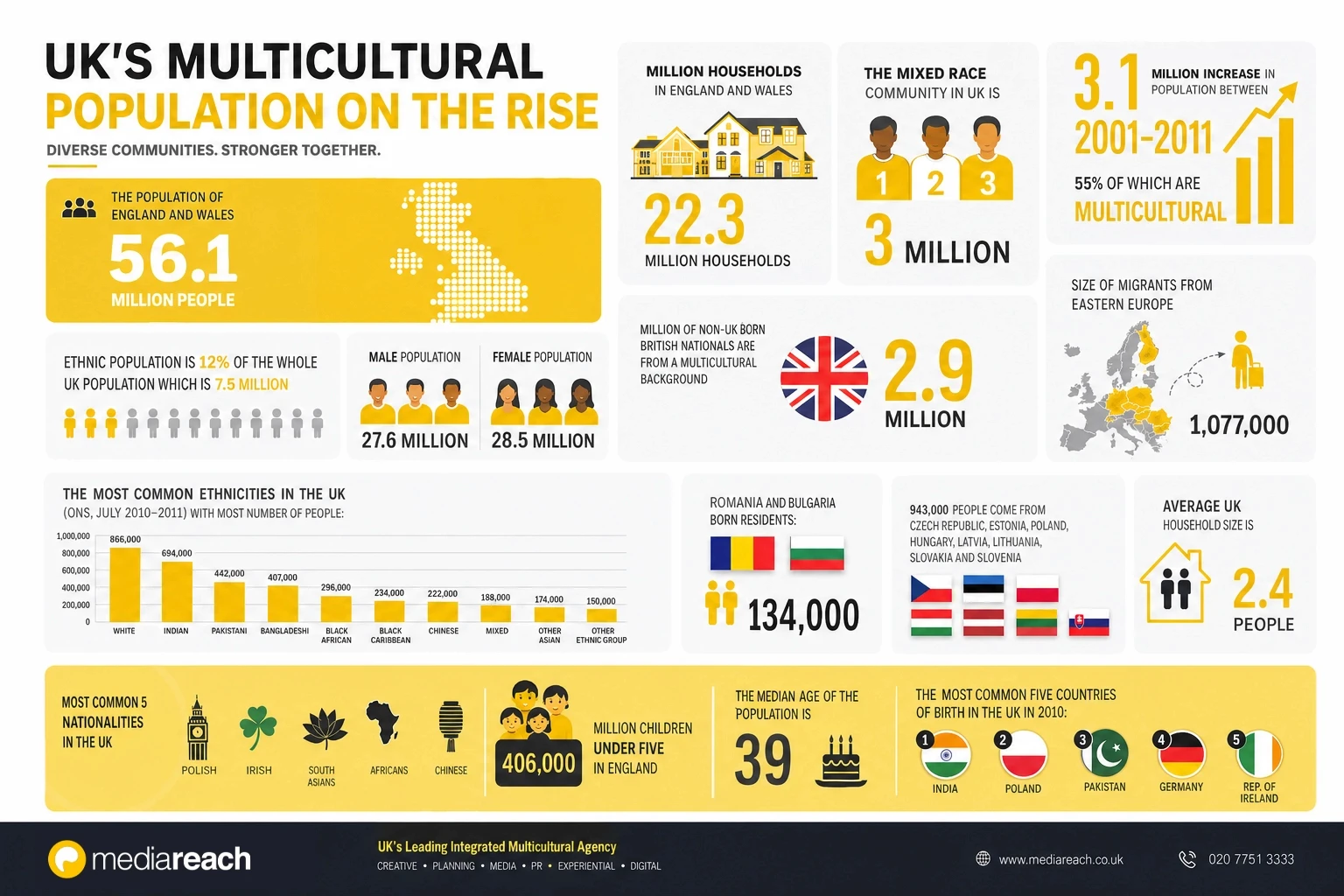
2021 Census: Ethnic Diversity at a Glance
• England and Wales population: 59.6 million • White British: 74.4% (down from 80.5% in 2011) • Asian: 9.3% (5.5 million) — largest ethnic minority group • Black: 4.0% (2.4 million) • Mixed: 2.9% (1.7 million) • Other: 2.1% (1.3 million) • London White British: 36.8% (down from 44.9% in 2011) • London multi-ethnic households: 763,000 (31% of households with more than one person) • Growth since 1991: Ethnic minority population tripled from 5.9% to 18.3%
What the Data Gets Wrong
We have argued for years that the official figures undercount the true scale of multicultural Britain. The 2021 Census was more comprehensive than 2011, with improved online completion and search-as-you-type functionality for self-identification. But challenges remain.
The census still misses some population groups. The number of people who identified as "any other ethnic background" jumped from 333,100 in 2011 to 923,800 in 2021 — suggesting many people do not see themselves in the standard categories. The Roma group was added for the first time in 2021, with over 100,000 people identifying, but this is widely believed to be a significant undercount. The census also relies on household-level reporting, which can miss complex living arrangements common in some communities.
Even without deep analysis, the direction of travel is unmistakable. The multicultural population is increasing fast and will become more visible in the near future. Simply accepting these facts is not enough. Clever business and marketing strategies must be developed to connect with the current UK population more effectively, taking into consideration their backgrounds, cultures, and media consumption habits.
The Strategic Imperative
Demographics have changed. Marketing strategies must reflect this too. In London's state-funded primary schools, 58.8% of pupils are from ethnically diverse backgrounds. In secondary schools, the figure is 62.3%. These children are the consumers of tomorrow. Brands that fail to build cultural intelligence now will find themselves irrelevant to the majority of the next generation.
For multicultural marketers, the 2021 Census is not just data. It is a strategic map. It tells us where to invest, which communities to prioritise, and which channels to use. It confirms that cultural media, community messaging, and niche marketing are not fringe activities. They are the mainstream of tomorrow.
Bottom line: The 2021 Census proves that Britain's multicultural population is larger, more dispersed, and more economically significant than ever before. The brands that win will be those that treat cultural intelligence as a core competency, not an afterthought. The data is clear. The opportunity is enormous. The only question is who acts first.

Turn Census Data into Commercial Strategy
Mediareach combines four decades of community expertise with data-driven insight to help brands connect with Britain's fastest-growing consumer segments.
Sources & References
ONS, "Population of England and Wales — Ethnicity Facts and Figures," 2021 Census, updated May 2024. ethnicity-facts-figures.service.gov.uk
ONS, "Census 2021 release on Ethnicity, National Identity, Language and Religion — London," December 2022. data.london.gov.uk
Simpson, L. and Jivraj, S., "A rapid response analysis of the 2021 Census of England and Wales," The Geographical Journal, January 2023. wiley.com
WPP, "The Consumer Equality Equation," November 2022. wpp.com
BITC, "Regional Insights on Race: London Factsheet," March 2023. bitc.org.uk
QMUL Mile End Institute, "The Diversity of Ethnic Minority Londoners," May 2024. qmul.ac.uk
Trust for London, "Demography, London's Population & Geography." trustforlondon.org.uk
ONS census 2021 multicultural Britain
UK ethnic minority population 2021
London diversity statistics
multicultural marketing business case
ethnic minority spending power UK
UK population diversity 2021
BAME population UK 2021
multicultural consumer market UK
ethnic minority disposable income
UK demographic change
London ethnic minority majority
multicultural population growth UK
precision marketing UK
cultural media marketing
niche marketing ethnic communities
The UK's pioneering multicultural marketing and advertising agency. Over 40 years connecting brands with diverse communities through cultural insight, creative excellence, and intelligent media strategy. mediareach.co


Jul 21, 2026
ONS 2021 Census: Britain Is More Multicultural Than Ever
Ethnic minorities now make up 18.3% of England and Wales. London is 46.2% diverse. Here is what the data means for brands, and why the one-size-fits-all approach is dead.
⏱ 5 min read
By Mediareach
It is not a surprise any more that the multicultural population is growing fast. For over four decades, Mediareach has been releasing analysis backed by data to bring the attention of UK businesses to this fundamental shift in demographics. The 2021 Census confirms what we have long known: Britain is more multicultural than ever.
According to the Office for National Statistics, the population of England and Wales reached 59.6 million in 2021. The ethnic minority population now stands at 10.9 million people — 18.3% of the total. That is up from 14% in 2011. The ethnic minority population has tripled since 1991, when it stood at just 5.9%. On current trajectories, almost one-third of the population will be ethnically diverse by 2051.
18.3%
of England and Wales population is from an ethnic minority background (2021)
10.9M
people from ethnic minority groups in England and Wales
46.2%
of London residents identify with Asian, Black, Mixed or other ethnic groups
10
London boroughs where ethnic minorities are now the majority (up from 6 in 2011)
The Scale of the Shift
The 2021 Census reveals a country being reshaped by diversity. The White British population fell from 80.5% in 2011 to 74.4% in 2021. The "Other White" group saw the largest proportional increase, reflecting continued European migration. The Black African population grew from approximately 990,000 to nearly 1.5 million. The Mixed ethnic group more than doubled since 2001, now standing at over 1.7 million people.
London remains the most diverse region, with 46.2% of residents identifying with Asian, Black, Mixed, or other ethnic groups. But diversity is not just a London story. In 2021, ten London boroughs had ethnic minority majorities — up from six in 2011. Newham leads at 69.2%, followed by Brent at 65.4% and Redbridge at 65.2%. Beyond the capital, Birmingham, Manchester, Leicester, and Slough all show significant ethnic minority populations that are growing, not plateauing.
"In cities such as London, 46.2% of the population is from an ethnic minority background. The diversity is what defines us more than ever. Cultural media, community messaging and niche marketing is becoming the conduit of the advertisers' in-the-know, who have already spotted the value for money and ROI that others are yet to catch onto."
Mediareach
The Business Case: Why This Matters for Brands
From a business perspective, these facts pose enormous opportunities. Businesses can no longer afford to ignore Britain's multicultural market if they want to strategically grow and increase market share. The UK has one of the most diverse cities in the world, where the ethnic population commands significant disposable income.
A 2022 WPP study, The Consumer Equality Equation, found that ethnic minority groups will account for almost a third of the UK adult population by 2061, with projected annual disposable income of £575 billion. By engaging just 1% of ethnic minority consumers to change their spending habits, brands could tap into a £2.34 billion short-term growth opportunity. The cumulative figure is staggering: up to £16.7 trillion in disposable income by 2061.
Consumer expectations have shifted decisively. The same WPP study found that 83% of all UK consumers believe brands should make more effort to understand different ethnic groups. 77% of ethnic minority consumers actively choose brands with a strong social purpose. When prices are falling and competition is fierce, the main strategy is segmentation and precision marketing. The one-size-fits-all approach has lost its relevance.
2021 Census: Ethnic Diversity at a Glance
• England and Wales population: 59.6 million • White British: 74.4% (down from 80.5% in 2011) • Asian: 9.3% (5.5 million) — largest ethnic minority group • Black: 4.0% (2.4 million) • Mixed: 2.9% (1.7 million) • Other: 2.1% (1.3 million) • London White British: 36.8% (down from 44.9% in 2011) • London multi-ethnic households: 763,000 (31% of households with more than one person) • Growth since 1991: Ethnic minority population tripled from 5.9% to 18.3%
What the Data Gets Wrong
We have argued for years that the official figures undercount the true scale of multicultural Britain. The 2021 Census was more comprehensive than 2011, with improved online completion and search-as-you-type functionality for self-identification. But challenges remain.
The census still misses some population groups. The number of people who identified as "any other ethnic background" jumped from 333,100 in 2011 to 923,800 in 2021 — suggesting many people do not see themselves in the standard categories. The Roma group was added for the first time in 2021, with over 100,000 people identifying, but this is widely believed to be a significant undercount. The census also relies on household-level reporting, which can miss complex living arrangements common in some communities.
Even without deep analysis, the direction of travel is unmistakable. The multicultural population is increasing fast and will become more visible in the near future. Simply accepting these facts is not enough. Clever business and marketing strategies must be developed to connect with the current UK population more effectively, taking into consideration their backgrounds, cultures, and media consumption habits.
The Strategic Imperative
Demographics have changed. Marketing strategies must reflect this too. In London's state-funded primary schools, 58.8% of pupils are from ethnically diverse backgrounds. In secondary schools, the figure is 62.3%. These children are the consumers of tomorrow. Brands that fail to build cultural intelligence now will find themselves irrelevant to the majority of the next generation.
For multicultural marketers, the 2021 Census is not just data. It is a strategic map. It tells us where to invest, which communities to prioritise, and which channels to use. It confirms that cultural media, community messaging, and niche marketing are not fringe activities. They are the mainstream of tomorrow.
Bottom line: The 2021 Census proves that Britain's multicultural population is larger, more dispersed, and more economically significant than ever before. The brands that win will be those that treat cultural intelligence as a core competency, not an afterthought. The data is clear. The opportunity is enormous. The only question is who acts first.
Turn Census Data into Commercial Strategy
Mediareach combines four decades of community expertise with data-driven insight to help brands connect with Britain's fastest-growing consumer segments.
Sources & References
ONS, "Population of England and Wales — Ethnicity Facts and Figures," 2021 Census, updated May 2024. ethnicity-facts-figures.service.gov.uk
ONS, "Census 2021 release on Ethnicity, National Identity, Language and Religion — London," December 2022. data.london.gov.uk
Simpson, L. and Jivraj, S., "A rapid response analysis of the 2021 Census of England and Wales," The Geographical Journal, January 2023. wiley.com
WPP, "The Consumer Equality Equation," November 2022. wpp.com
BITC, "Regional Insights on Race: London Factsheet," March 2023. bitc.org.uk
QMUL Mile End Institute, "The Diversity of Ethnic Minority Londoners," May 2024. qmul.ac.uk
Trust for London, "Demography, London's Population & Geography." trustforlondon.org.uk
ONS census 2021 multicultural Britain
UK ethnic minority population 2021
London diversity statistics
multicultural marketing business case
ethnic minority spending power UK
UK population diversity 2021
BAME population UK 2021
multicultural consumer market UK
ethnic minority disposable income
UK demographic change
London ethnic minority majority
multicultural population growth UK
precision marketing UK
cultural media marketing
niche marketing ethnic communities
The UK's pioneering multicultural marketing and advertising agency. Over 40 years connecting brands with diverse communities through cultural insight, creative excellence, and intelligent media strategy. mediareach.co
Jul 21, 2026
ONS 2021 Census: Britain Is More Multicultural Than Ever
Ethnic minorities now make up 18.3% of England and Wales. London is 46.2% diverse. Here is what the data means for brands, and why the one-size-fits-all approach is dead.
⏱ 5 min read
By Mediareach
It is not a surprise any more that the multicultural population is growing fast. For over four decades, Mediareach has been releasing analysis backed by data to bring the attention of UK businesses to this fundamental shift in demographics. The 2021 Census confirms what we have long known: Britain is more multicultural than ever.
According to the Office for National Statistics, the population of England and Wales reached 59.6 million in 2021. The ethnic minority population now stands at 10.9 million people — 18.3% of the total. That is up from 14% in 2011. The ethnic minority population has tripled since 1991, when it stood at just 5.9%. On current trajectories, almost one-third of the population will be ethnically diverse by 2051.
18.3%
of England and Wales population is from an ethnic minority background (2021)
10.9M
people from ethnic minority groups in England and Wales
46.2%
of London residents identify with Asian, Black, Mixed or other ethnic groups
10
London boroughs where ethnic minorities are now the majority (up from 6 in 2011)
The Scale of the Shift
The 2021 Census reveals a country being reshaped by diversity. The White British population fell from 80.5% in 2011 to 74.4% in 2021. The "Other White" group saw the largest proportional increase, reflecting continued European migration. The Black African population grew from approximately 990,000 to nearly 1.5 million. The Mixed ethnic group more than doubled since 2001, now standing at over 1.7 million people.
London remains the most diverse region, with 46.2% of residents identifying with Asian, Black, Mixed, or other ethnic groups. But diversity is not just a London story. In 2021, ten London boroughs had ethnic minority majorities — up from six in 2011. Newham leads at 69.2%, followed by Brent at 65.4% and Redbridge at 65.2%. Beyond the capital, Birmingham, Manchester, Leicester, and Slough all show significant ethnic minority populations that are growing, not plateauing.
"In cities such as London, 46.2% of the population is from an ethnic minority background. The diversity is what defines us more than ever. Cultural media, community messaging and niche marketing is becoming the conduit of the advertisers' in-the-know, who have already spotted the value for money and ROI that others are yet to catch onto."
Mediareach
The Business Case: Why This Matters for Brands
From a business perspective, these facts pose enormous opportunities. Businesses can no longer afford to ignore Britain's multicultural market if they want to strategically grow and increase market share. The UK has one of the most diverse cities in the world, where the ethnic population commands significant disposable income.
A 2022 WPP study, The Consumer Equality Equation, found that ethnic minority groups will account for almost a third of the UK adult population by 2061, with projected annual disposable income of £575 billion. By engaging just 1% of ethnic minority consumers to change their spending habits, brands could tap into a £2.34 billion short-term growth opportunity. The cumulative figure is staggering: up to £16.7 trillion in disposable income by 2061.
Consumer expectations have shifted decisively. The same WPP study found that 83% of all UK consumers believe brands should make more effort to understand different ethnic groups. 77% of ethnic minority consumers actively choose brands with a strong social purpose. When prices are falling and competition is fierce, the main strategy is segmentation and precision marketing. The one-size-fits-all approach has lost its relevance.
2021 Census: Ethnic Diversity at a Glance
• England and Wales population: 59.6 million • White British: 74.4% (down from 80.5% in 2011) • Asian: 9.3% (5.5 million) — largest ethnic minority group • Black: 4.0% (2.4 million) • Mixed: 2.9% (1.7 million) • Other: 2.1% (1.3 million) • London White British: 36.8% (down from 44.9% in 2011) • London multi-ethnic households: 763,000 (31% of households with more than one person) • Growth since 1991: Ethnic minority population tripled from 5.9% to 18.3%
What the Data Gets Wrong
We have argued for years that the official figures undercount the true scale of multicultural Britain. The 2021 Census was more comprehensive than 2011, with improved online completion and search-as-you-type functionality for self-identification. But challenges remain.
The census still misses some population groups. The number of people who identified as "any other ethnic background" jumped from 333,100 in 2011 to 923,800 in 2021 — suggesting many people do not see themselves in the standard categories. The Roma group was added for the first time in 2021, with over 100,000 people identifying, but this is widely believed to be a significant undercount. The census also relies on household-level reporting, which can miss complex living arrangements common in some communities.
Even without deep analysis, the direction of travel is unmistakable. The multicultural population is increasing fast and will become more visible in the near future. Simply accepting these facts is not enough. Clever business and marketing strategies must be developed to connect with the current UK population more effectively, taking into consideration their backgrounds, cultures, and media consumption habits.
The Strategic Imperative
Demographics have changed. Marketing strategies must reflect this too. In London's state-funded primary schools, 58.8% of pupils are from ethnically diverse backgrounds. In secondary schools, the figure is 62.3%. These children are the consumers of tomorrow. Brands that fail to build cultural intelligence now will find themselves irrelevant to the majority of the next generation.
For multicultural marketers, the 2021 Census is not just data. It is a strategic map. It tells us where to invest, which communities to prioritise, and which channels to use. It confirms that cultural media, community messaging, and niche marketing are not fringe activities. They are the mainstream of tomorrow.
Bottom line: The 2021 Census proves that Britain's multicultural population is larger, more dispersed, and more economically significant than ever before. The brands that win will be those that treat cultural intelligence as a core competency, not an afterthought. The data is clear. The opportunity is enormous. The only question is who acts first.
Turn Census Data into Commercial Strategy
Mediareach combines four decades of community expertise with data-driven insight to help brands connect with Britain's fastest-growing consumer segments.
Sources & References
ONS, "Population of England and Wales — Ethnicity Facts and Figures," 2021 Census, updated May 2024. ethnicity-facts-figures.service.gov.uk
ONS, "Census 2021 release on Ethnicity, National Identity, Language and Religion — London," December 2022. data.london.gov.uk
Simpson, L. and Jivraj, S., "A rapid response analysis of the 2021 Census of England and Wales," The Geographical Journal, January 2023. wiley.com
WPP, "The Consumer Equality Equation," November 2022. wpp.com
BITC, "Regional Insights on Race: London Factsheet," March 2023. bitc.org.uk
QMUL Mile End Institute, "The Diversity of Ethnic Minority Londoners," May 2024. qmul.ac.uk
Trust for London, "Demography, London's Population & Geography." trustforlondon.org.uk
ONS census 2021 multicultural Britain
UK ethnic minority population 2021
London diversity statistics
multicultural marketing business case
ethnic minority spending power UK
UK population diversity 2021
BAME population UK 2021
multicultural consumer market UK
ethnic minority disposable income
UK demographic change
London ethnic minority majority
multicultural population growth UK
precision marketing UK
cultural media marketing
niche marketing ethnic communities
The UK's pioneering multicultural marketing and advertising agency. Over 40 years connecting brands with diverse communities through cultural insight, creative excellence, and intelligent media strategy. mediareach.co